



Human-Rating a Rocket for a Precious Cargo
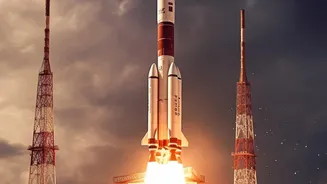
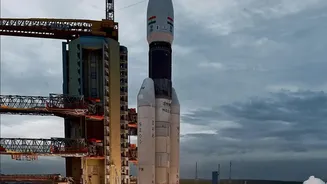
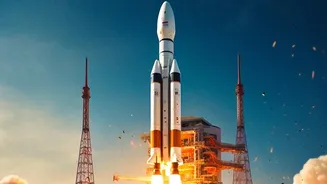
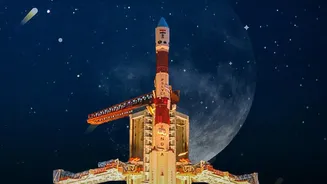
Sending a satellite into space is complex, but sending humans is an entirely different challenge. The core of Gaganyaan's safety lies in the 'human-rating' of its launch vehicle, the powerful LVM3 rocket. This process involves upgrading the reliable launcher,
now called HLVM3 (Human-Rated LVM3), to meet the highest standards of crew safety. Unlike a satellite mission, there is no room for error. Human-rating involves adding redundant systems, meaning critical components have backups that can take over instantly in case of a failure. Engineers have made numerous systems more reliable, strengthened engines, and conducted exhaustive tests far beyond what is required for a standard launch, all to minimize risk and ensure the vehicle is robust enough to carry a human crew.
The Ultimate Insurance: The Crew Escape System
What if something goes wrong during the most dangerous phase of the mission — the launch? For this, ISRO has developed a critical safety net: the Crew Escape System (CES). This system is designed to act like a high-speed ejector seat for the entire crew capsule. In the event of an emergency on the launchpad or during ascent, a set of quick-acting solid-fuel motors will fire, pulling the crew module away from the malfunctioning rocket at immense speed. The system is intelligent, with different motors for different altitudes to ensure a safe escape whether the emergency occurs seconds after ignition or high up in the atmosphere. ISRO has conducted a series of demonstrator missions, including Pad Abort Tests, to prove this life-saving technology works flawlessly.
A Sanctuary in the Sky: The Crew Module
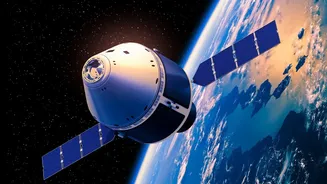
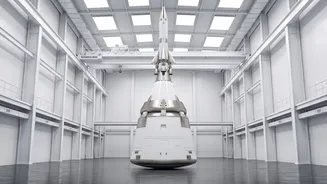
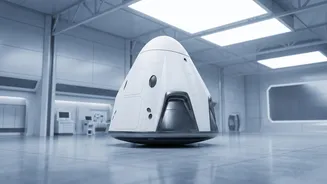
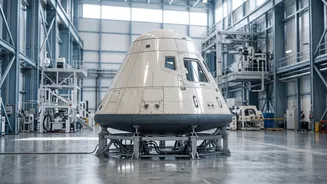
The Gaganyaan Crew Module is more than just a transport pod; it is the astronauts' home and sanctuary in the harsh environment of space. It features a double-walled construction with a pressurized metallic inner structure where the crew will live and work. This is enclosed by an external structure fitted with a Thermal Protection System to withstand the extreme heat of re-entry. The module houses all essential crew interfaces, life support systems providing an Earth-like environment, and the avionics needed to command the spacecraft. Its design has been meticulously refined, incorporating lessons from precursor missions and extensive ground simulations coordinated by the Human Space Flight Centre (HSFC) in Bengaluru.
Testing for a Safe Return to Earth
Getting to space is only half the journey. Bringing the crew back safely is paramount, and this relies on a perfectly executed re-entry and landing sequence. To validate this, ISRO has been conducting a series of Integrated Air Drop Tests (IADT). In these tests, a simulated crew module is dropped from a high altitude by an Indian Air Force Chinook helicopter to test the complex parachute deployment system. The system uses a sequence of ten parachutes—including smaller drogue parachutes to stabilize and slow the capsule, followed by three massive main parachutes—to gently reduce the landing speed for a safe splashdown in the sea. Successful tests, including the recent IADT-02, have proven the reliability of this critical deceleration system.
Final Checks for a Perfect Splashdown
The safety checks extend to the very last moments of the mission. Recent qualification tests have focused on the crucial events after the parachutes have done their job. One major test validated the Crew Module Up-righting System (CMUS), which uses inflatable bags to ensure the capsule remains upright after landing in the ocean, even in choppy seas. Another test confirmed the clean separation of the crew module from its service module just before re-entry, a step vital for a stable descent. Engineers also verified the structural strength of the capsule to withstand the force of the parachute cover being jettisoned. These painstaking tests highlight ISRO's commitment to verifying every single component, as there is zero margin for error when human lives are at stake.