
Our Sun gives life, but it also has a violent temper. Huge eruptions can hurl plasma across space, threatening satellites and power grids on Earth. A new partnership between India's Aditya-L1 and Europe's Proba-3 missions offers a powerful new way to
study these solar storms right as they begin.
India’s Unblinking Eye on the Sun
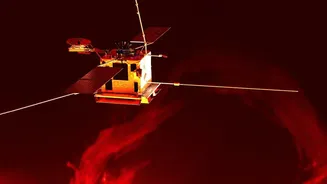
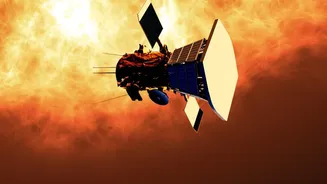
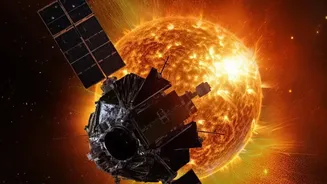
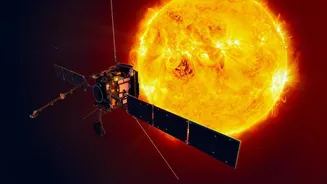
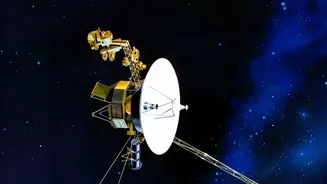
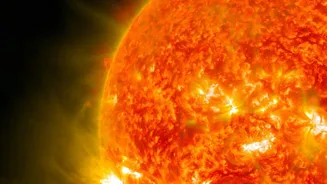
Launched in September 2023, Aditya-L1 is India’s first dedicated solar observatory, a landmark achievement for ISRO. It is strategically positioned at Lagrange Point 1 (L1), a spot 1.5 million kilometres from Earth where the gravitational pull of the Sun and Earth balance out. This gives it an uninterrupted, 24/7 view of the Sun, free from eclipses or occultations. Aditya-L1 is equipped with seven sophisticated instruments designed to study everything from the Sun’s surface to its outer atmosphere, the corona. At the heart of its mission is the Visible Emission Line Coronagraph (VELC). Unlike a standard camera, VELC is a spectrograph; it analyses the properties of the light from the corona to determine the temperature, density, and speed of the superheated plasma, offering deep insights into the physics of the Sun’s atmosphere.
Europe’s Precision Artificial Eclipse
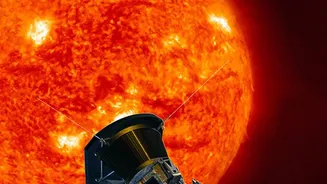
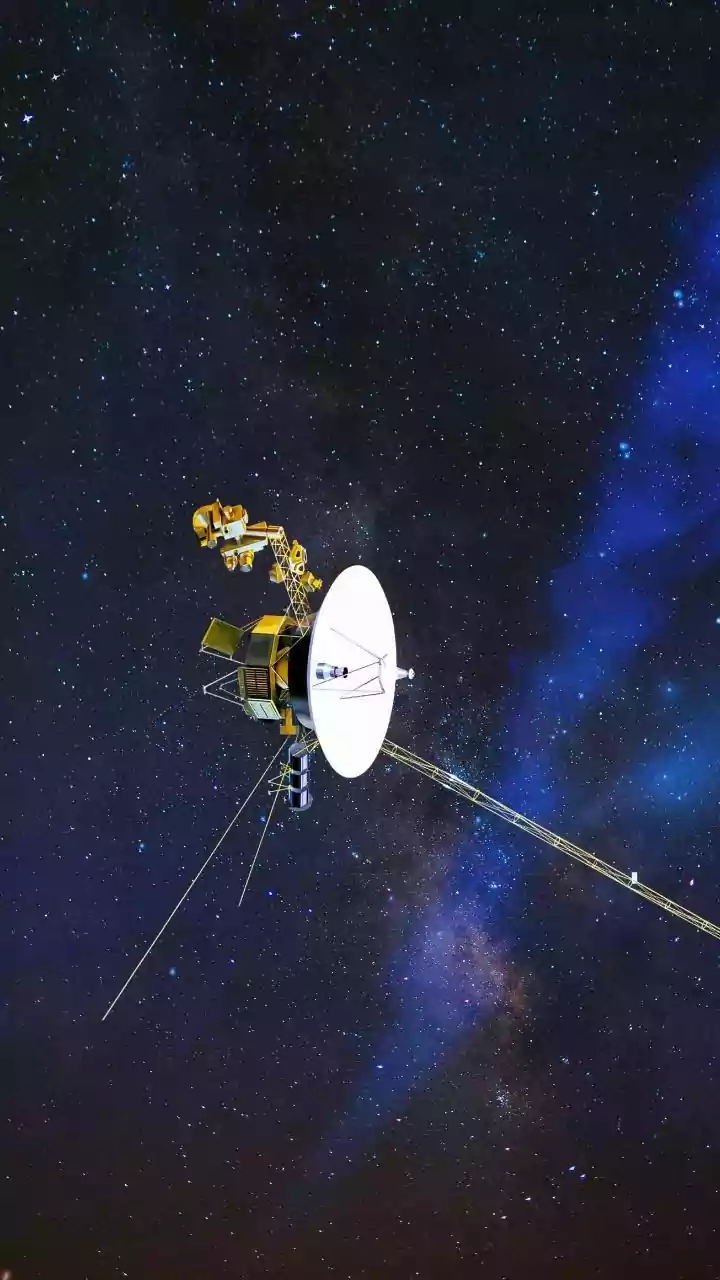
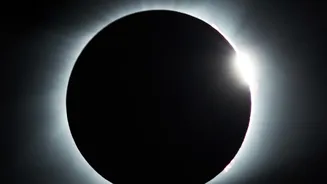
The European Space Agency’s (ESA) Proba-3 mission, launched in December 2024 by an Indian PSLV rocket, is a marvel of engineering. It is the world’s first precision formation-flying mission, consisting of two separate spacecraft. One spacecraft, the 'Occulter', flies about 150 metres in front of the second, the 'Coronagraph'. They maintain their position with millimetre accuracy to create a near-perfect artificial eclipse that lasts for hours at a time. This technique blocks the blinding glare of the Sun’s main disk far more effectively than any single-satellite coronagraph. It allows Proba-3’s main instrument, ASPIICS, to capture incredibly sharp images of the faint, inner corona—a mysterious region very close to the solar surface where eruptions are born, which has been notoriously difficult to observe until now.
A Partnership Forged in Science
The collaboration between Aditya-L1 and Proba-3 is not a formal joint mission but a powerful scientific synergy. Researchers, including scientists at India’s Institute of Astrophysics, realised that combining the data from these two advanced observatories could reveal more than either could alone. The two missions offer highly complementary views of the same phenomena. Proba-3’s ASPIICS instrument provides crisp, high-resolution images, allowing scientists to accurately map the shape, size, and movement of a solar eruption as it leaves the Sun. Meanwhile, Aditya-L1's VELC uses spectroscopy to diagnose the physical state of the gas within that eruption, measuring its temperature and density. This combination provides a more complete, cross-checked understanding of an eruption's evolution.
Decoding Violent Solar Eruptions
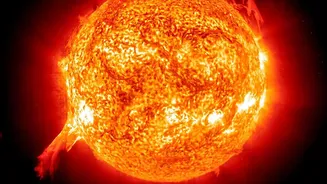
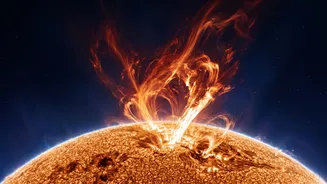
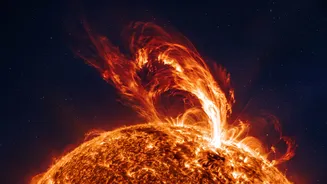
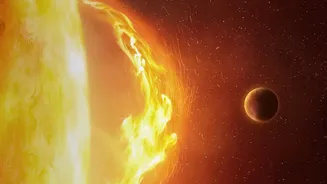
These eruptions, known as Coronal Mass Ejections (CMEs), are massive explosions of magnetised plasma from the Sun. When a CME strikes Earth, it can trigger geomagnetic storms that disrupt satellite operations, communications, GPS navigation, and even power grids. To better predict their impact, we need to understand how they are initiated and gain energy in their earliest moments. This is where the joint observations are proving invaluable. In a recent study of two CMEs, scientists combined VELC and ASPIICS data to measure the mass, density, and energy of the eruptions right as they were forming. They could see how the energy was distributed between motion and heat, providing crucial new details that were previously unobtainable. This allows for better models of how a CME will behave as it travels through space.
Why Two Views Are Better Than One
Think of it like trying to understand a thunderstorm. One instrument (Proba-3) acts like a high-resolution camera, taking sharp pictures of a lightning bolt's exact shape and path as it emerges from the clouds. The other instrument (Aditya-L1) acts like a set of scientific sensors measuring the temperature, pressure, and electrical charge inside that same thundercloud. Separately, they each tell part of the story. But together, they give a complete, three-dimensional picture of the storm's power and behaviour. The partnership between Aditya-L1 and Proba-3 provides this comprehensive view of solar storms, confirming the immense scientific value of both missions and showcasing India's role at the forefront of space science. The ability to cross-validate findings from two different instruments builds confidence and refines our understanding of the fundamental physics driving our star.