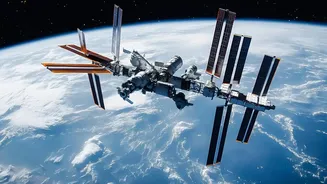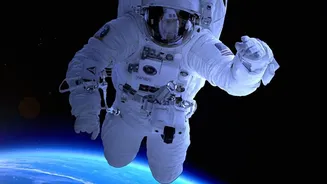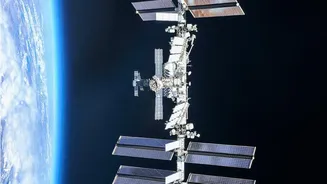

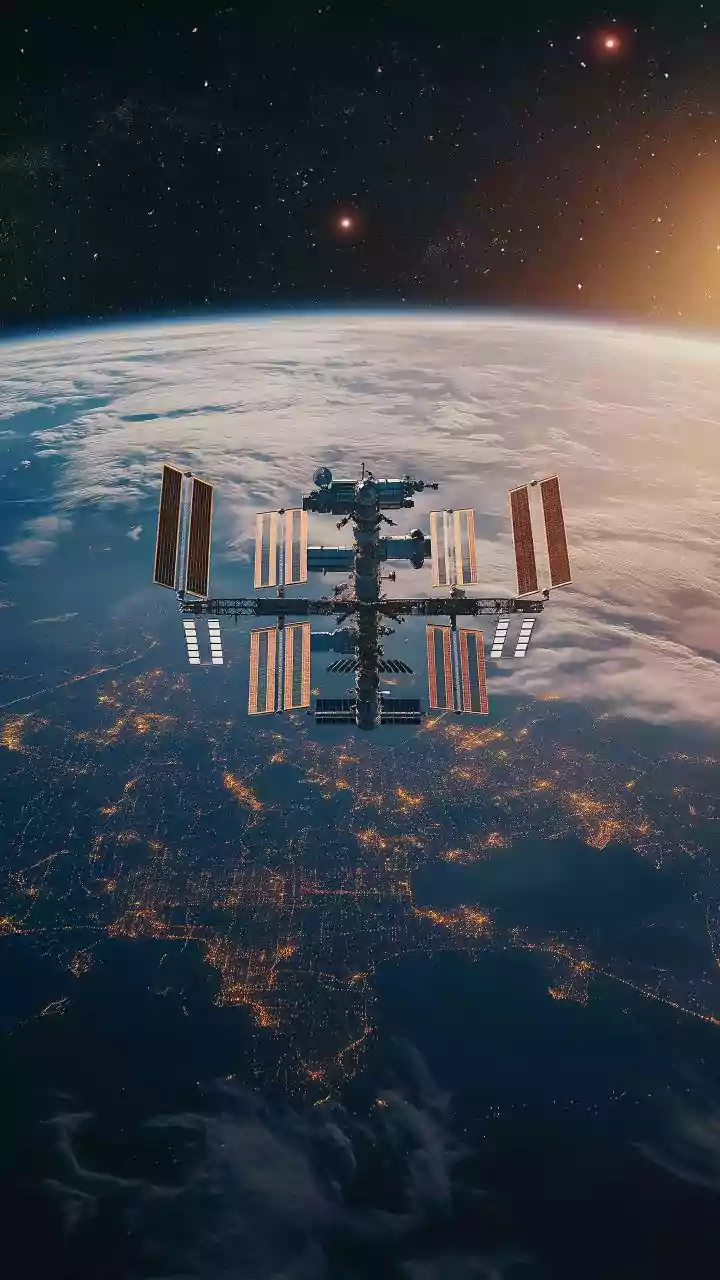

Think of astronauts floating on the International Space Station and you probably picture 'zero gravity'. But that's a myth. In reality, gravity is still pulling on them, just as it pulls on you. So why doesn't it just stop at the edge of our atmosphere?
Gravity Is About Mass, Not Just Closeness
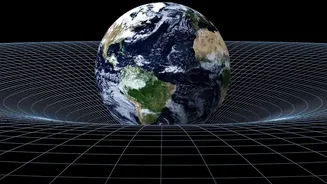
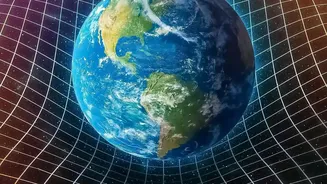
The first thing to get your head around is that gravity isn't something that switches off. According to Sir Isaac Newton's universal law of gravitation, every object with mass in the universe pulls on every other object with mass. The more massive the objects, the stronger the pull. Think about it: you have mass, and the Earth has a whole lot of mass. That's why you're stuck to it. The same principle applies to the sun holding the planets in orbit. Earth's gravity doesn't exist just on its surface; it’s a property of its immense mass, and that influence extends far beyond the ground we stand on. It’s a universal attraction, not a localized phenomenon.
The Inverse-Square Law: Fading, Not Failing
So if gravity is everywhere, why do we feel it so strongly here but astronauts seem to float? The secret is something called the inverse-square law. It sounds complicated, but the idea is simple. Imagine a flashlight. The closer you are to the bulb, the brighter the light. As you move away, the light spreads out over a larger area and becomes dimmer. Gravity works in a similar way. Its force weakens with distance. Specifically, if you double your distance from the center of an object, the gravitational force you feel is only one-quarter as strong. If you triple the distance, it’s one-ninth as strong. The key is that the force gets weaker and weaker, but it never actually reaches zero. Theoretically, Earth's gravity extends infinitely, though it quickly becomes too faint to notice compared to the pull of larger or closer objects.
The Real Reason Astronauts Float
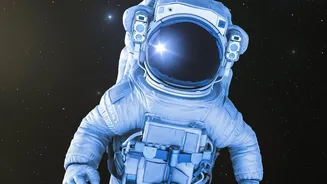
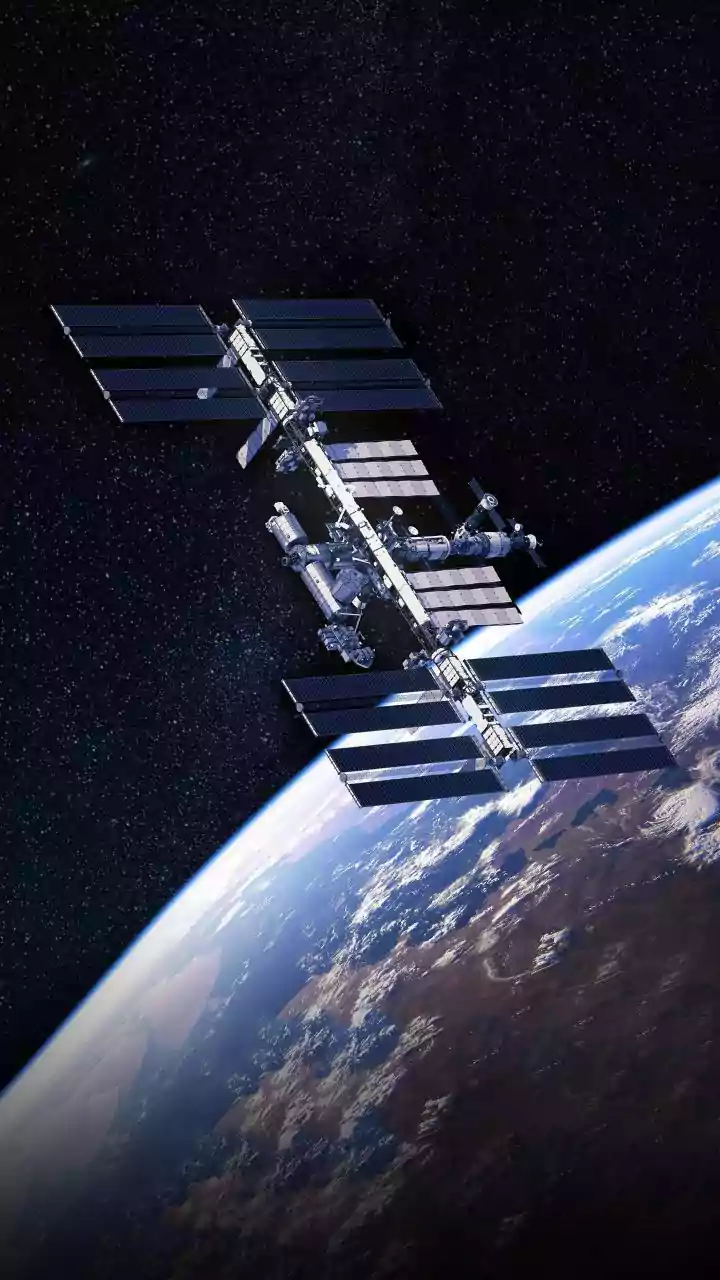
Here’s the big misconception: astronauts on the International Space Station (ISS) aren't floating because they've escaped gravity. At their altitude of around 400 kilometers (about 250 miles), Earth’s gravity is still about 90% as strong as it is on the surface. A 150-pound person would still weigh about 135 pounds up there. So why do they float? The answer is that they are in a constant state of free-fall. The ISS and everything inside it are falling towards Earth, but they are also moving sideways at an incredible speed—about 17,500 miles per hour. This immense sideways velocity means that as they fall, the curved surface of the Earth drops away from them at the same rate. They are constantly falling 'around' the Earth, but never hitting it. It’s like being in an elevator where the cable has snapped; you, the elevator, and a ball you let go of would all fall together, making the ball appear to float in front of you.
Gravity’s Long Reach: A Cosmic Choreographer
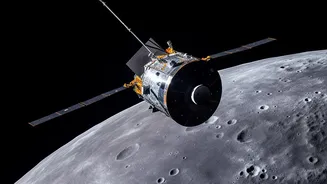
This persistent, long-distance pull is absolutely essential for our world and our technology. It’s what keeps the Moon locked in its orbit around the Earth, about 384,400 kilometers away. Within a certain range, known as Earth's 'Hill sphere' which extends about 1.5 million kilometers, our planet's gravity is the dominant force. Beyond that, the Sun's massive gravitational pull takes over. Every communications satellite, GPS signal, and weather forecast we rely on depends on this delicate balance. Engineers place satellites at just the right altitude and speed so that Earth’s gravity continuously pulls them into a stable orbit, allowing them to do their jobs without flying off into the void or crashing back to the surface. It’s a cosmic dance choreographed by a force that weakens with distance but never truly lets go.