





An Ambitious Leap to an Alien Moon
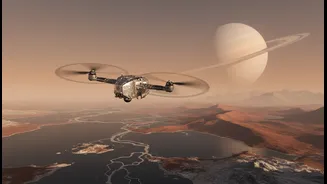
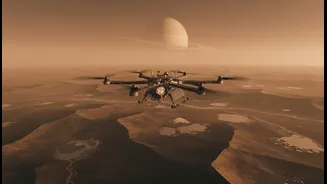
Set to launch in July 2028, the Dragonfly mission is one of NASA's most audacious projects. Its destination is Titan, Saturn's largest moon, a world unlike any other in our solar system. Larger than the planet Mercury, Titan has a thick nitrogen atmosphere,
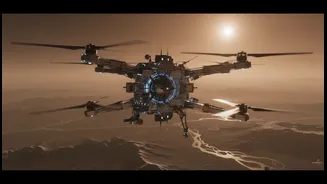
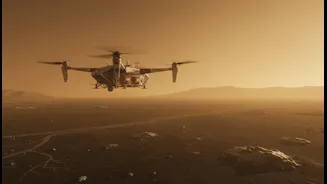
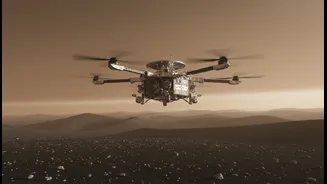
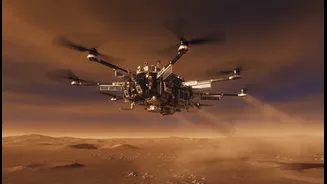
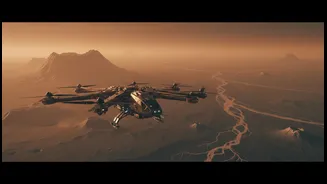
weather systems, and rivers and lakes of liquid methane. The goal is to send a dual-rotor quadcopter to this world, have it land, and then perform a series of 'hops' to explore different locations. Over its planned three-year mission, Dragonfly will fly to dozens of promising sites to study whether Titan’s complex, carbon-rich chemistry could be a cradle for life. This $3.35 billion mission, led by the Johns Hopkins Applied Physics Laboratory (APL), represents a new frontier in planetary exploration, moving beyond stationary landers and wheeled rovers to take to the skies of another world.
Pushing the Limits with Earth-Based Tests
To prepare for this journey, engineers have been conducting exhaustive tests. From structural analyses to ensure the lightweight frame can survive the launch, to thermal testing of its insulation against Titan’s frigid -180°C temperatures, every component is being pushed to its limit. NASA has used specialized wind tunnels, like the Transonic Dynamics Tunnel at Langley Research Center, to simulate how Dragonfly's rotors will perform in Titan's unique environment by using a heavy gas to mimic the moon's dense atmosphere. These tests have already led to design changes, such as altering the alignment of the rotors to prevent air pressure interference. The mission’s complex software, which must allow Dragonfly to fly and land autonomously due to the 90-minute communication delay, is also undergoing intense simulation and verification.
Why Earth Is Not Titan
Despite this rigorous testing, a fundamental challenge remains: Earth is not Titan. While flight on Titan is in some ways easier thanks to its low gravity and thick atmosphere, we cannot perfectly replicate its conditions. Titan's atmosphere is about four times denser than Earth's, while its gravity is only one-seventh as strong. This creates a unique aerodynamic environment. As one NASA official noted, it's like a jigsaw puzzle where you can never get all the parameters right at the same time. Engineers can test for the cold, test for the atmospheric density in simulations, and test the hardware's durability, but they cannot put it all together in a real-world Titan environment until the spacecraft actually arrives in 2034.
The One-Shot Gamble of Arrival
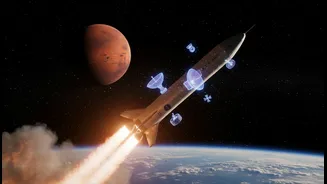
The risks begin long before the first flight on Titan. First, there's the launch aboard a SpaceX Falcon Heavy rocket, an inherently high-stakes event. Then comes the six-year cruise through deep space. But the most nerve-wracking phase may be the entry, descent, and landing. Lasting nearly two hours, far longer than the 'seven minutes of terror' for Mars landings, Dragonfly's capsule will plunge through Titan’s hazy atmosphere. The craft must survive extreme heat during entry, deploy parachutes correctly to manage a long, slow descent, and then, at an altitude of about 1.2 kilometers, release from the parachute and fire up its rotors for a powered, autonomous landing. This entire sequence is a one-shot affair; there are no second chances or rehearsals.
Unknowns on the Ground and in the Air
Even after a successful landing, the mission will be fraught with uncertainty. The surface at the landing site could be different than expected, and the downwash from the powerful rotors could kick up debris that damages sensitive instruments. While the first flights will target flat, dune-filled regions, every takeoff and landing on a surface we've barely seen is a new experiment. A surprising discovery during the design phase was that the craft's nuclear power source, essential for staying warm, could actually cause it to overheat on a calm day without a breeze. This highlights the kinds of unexpected challenges that arise when designing for an alien environment. The mission’s success depends on an autonomous system making correct decisions millions of kilometres from human controllers, navigating a world full of known and unknown unknowns.