


A Mission of Unprecedented Complexity
Chandrayaan-4 represents a monumental leap in capability for India's space program. While Chandrayaan-3 proved ISRO could master a soft landing, this new mission aims to land, collect samples, and then launch off the Moon to return them to Earth. This
makes India only the fourth nation to ever attempt such a feat, after the US, the former Soviet Union, and China. The mission, which received cabinet approval in September 2024, is far more complex than its predecessor. It involves at least four major technologies that ISRO has never combined in a single mission: a robotic collection system, a launch from the lunar surface, automated docking in orbit, and a high-speed reentry to Earth. ISRO Chairman S. Somanath has called the mission "extremely challenging" and a crucial first step toward the larger goal of landing an Indian astronaut on the Moon by 2040.
The Two-Launch, Five-Module Strategy
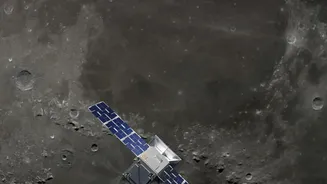
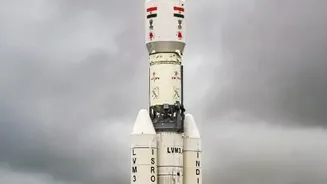
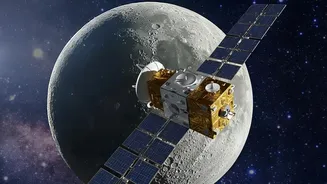
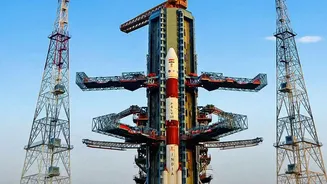
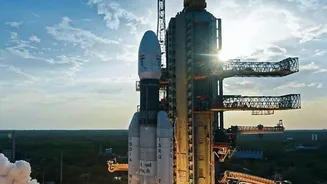
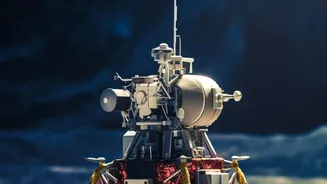
Due to the sheer mass and complexity, the Chandrayaan-4 mission cannot be launched on a single rocket. The entire spacecraft will consist of five separate modules with a combined weight of over 9,000 kg, more than double that of Chandrayaan-3. This has forced ISRO to devise an innovative two-launch strategy using its most powerful rocket, the LVM3. The first launch will carry the Descender Module (the lander) and the Ascender Module. The second launch will carry a Propulsion Module, a Transfer Module, and a Re-entry Module. These two stacks will then meet and dock in Earth's orbit—a critical maneuver in itself—before the combined craft begins its journey to the Moon. This orbital docking capability was successfully tested with the SPADEX mission, which ISRO confirmed was a precursor for Chandrayaan-4.
How the Sample Return Works
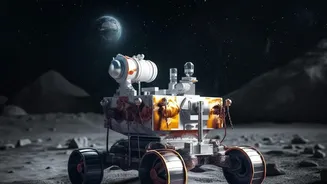
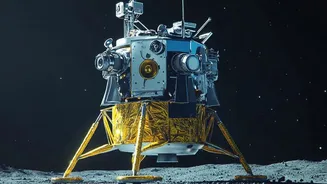
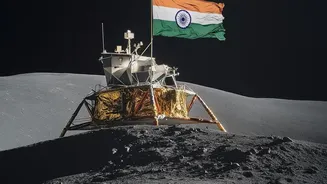
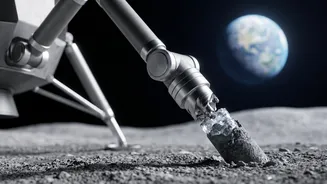
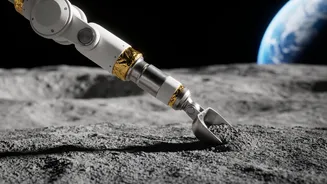
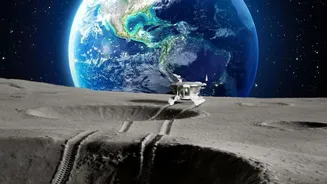
Once in lunar orbit, the lander and ascender will separate and perform a soft landing near the Moon's south pole, a region believed to be rich in water ice. After landing, a robotic arm on the lander will scoop up surface soil, while a drill will collect subsurface samples. These samples, weighing around 2-3 kg, will be transferred into containers on the Ascender Module and sealed to prevent contamination. The next critical phase is the ascent. The Ascender will use the lander as a launchpad to lift off from the lunar surface and enter lunar orbit. There, it will autonomously dock with the Transfer Module that has been waiting. The samples will be transferred to the Re-entry Module, which is designed to protect them during the fiery return through Earth's atmosphere. The Transfer Module will then guide the Re-entry Module back towards Earth before it performs a final ballistic re-entry and landing.
Why Bring Lunar Samples to Earth?
Studying lunar samples on Earth offers scientific possibilities that remote instruments on a rover simply cannot match. Laboratories on Earth can use massive, highly sensitive equipment like electron microscopes and mass spectrometers to analyze the samples' composition and age with incredible precision. This can unlock secrets about the origin and evolution of the Moon, Earth, and the inner solar system. Furthermore, samples from the lunar south pole are of immense global interest. Previous samples returned by the Apollo and Luna missions came from different geological zones. Analyzing pristine material from the polar regions, which may contain frozen water ice, could be a game-changer for understanding lunar resources and planning future human habitats on the Moon.