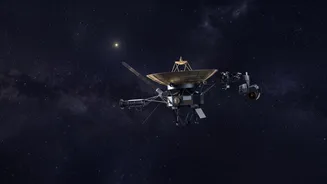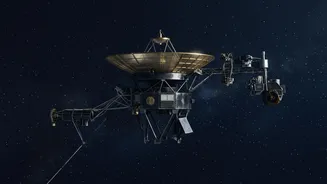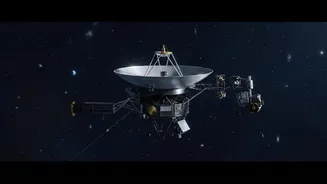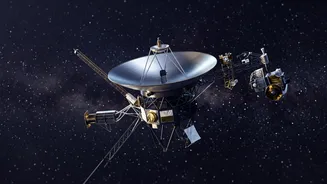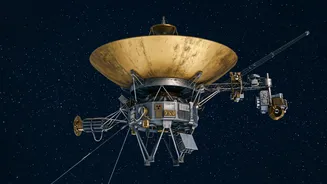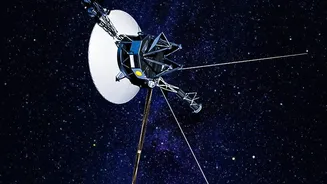



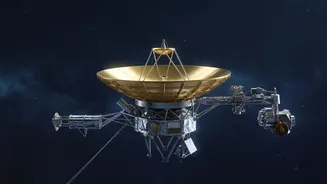
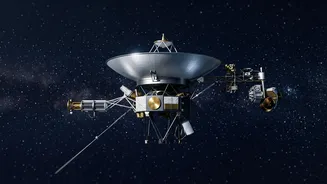
On November 18, 2026, humanity’s farthest envoy will achieve something unprecedented. Voyager 1, a relic of the 1970s, will be a full light-day from Earth, a testament to endurance and a milestone that redefines what it means to be distant.
A Journey Measured in Light
To say Voyager
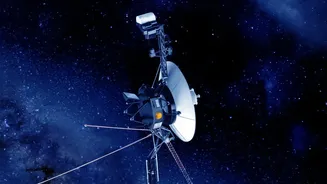
1 is far away is an understatement. On November 18, the spacecraft will be approximately 25.9 billion kilometers from home. The distance is so vast that it becomes almost meaningless without a new yardstick: the speed of light. A light-day is the distance light travels in 24 hours. Communicating with Voyager 1 will now mean sending a signal, waiting a full day for it to arrive, and then another full day for its reply. This 48-hour round trip for a simple 'hello' highlights the immense challenge of piloting a nearly 50-year-old probe in interstellar space. Launched in 1977, it has taken Voyager 1 over 49 years to travel a distance that light crosses in a single day. No other object built by human hands has ever come close to this achievement.
The Grand Tour's Unexpected Epilogue
Voyager 1 and its twin, Voyager 2, were never designed for such a long journey. Their original mission was a 'Grand Tour' of the outer planets, taking advantage of a rare planetary alignment. After stunning flybys of Jupiter and Saturn, and providing the first detailed images of their moons, Voyager 1's planetary mission concluded in 1980. Its trajectory was altered to study Saturn’s giant moon Titan, which flung it upwards and out of the plane of the solar system, setting it on a path toward the stars. In August 2012, it officially entered interstellar space, crossing the 'heliopause'—the boundary where the Sun's magnetic field and particle influence ends. It has been exploring this uncharted territory ever since, becoming humanity's first and only active interstellar messenger.
An Aging Explorer's Recent Scare
Keeping a vintage spacecraft running is a masterclass in creative engineering. Voyager 1 is powered by radioisotope thermoelectric generators, which convert heat from decaying plutonium into electricity. With its power supply dwindling by about 4 watts per year, NASA engineers must make difficult choices about which instruments to shut down. Recently, they executed a clever power-saving maneuver nicknamed the 'Big Bang', swapping to lower-power devices to extend the mission. The mission faced a scare in October 2026 when, for 48 hours, the Deep Space Network lost contact. The probe resolved the issue on its own, with its backup thrusters activating automatically, a testament to its robust 1970s engineering. Communication has since been stable, but the incident was a stark reminder of the probe's age and the unexpected challenges it faces.
A Message in a Cosmic Bottle
Beyond its scientific instruments, Voyager 1 carries a message of peace and curiosity: the Golden Record. This gold-plated copper disk contains sounds and images selected to portray the diversity of life and culture on Earth. It includes greetings in 55 languages, music from different eras and cultures, and 115 images of our world and our species. It is a time capsule, a message in a bottle cast into the cosmic ocean, intended for any intelligent extraterrestrial life that might one day encounter the silent probe. The record is a poignant symbol of the mission's dual purpose: to explore the cosmos and to represent who we are. One of the last images Voyager 1 ever took, in 1990, was the famous 'Pale Blue Dot,' showing Earth as a tiny speck of light in the vast darkness—a photo that powerfully captures our place in the universe.
The Long, Silent Journey Ahead
The light-day milestone is a profound achievement, but it's just another step in an almost eternal journey. While its scientific mission may only last into the 2030s before its power finally fades, the spacecraft itself will continue. Traveling at nearly 61,000 kilometers per hour, it is coasting toward an obscure star called Gliese 445. It will not get close, however, for another 40,000 years. Long after its signals cease and its human creators are gone, Voyager $will$ drift through the Milky Way galaxy, a silent ambassador carrying a record of a world that sent it on its way. It is a monument not just to engineering, but to the uniquely human impulse to reach out into the unknown.