



The Old Textbook Definition
For decades, our picture of the solar system was tidy. Circling the sun between Mars and Jupiter is the main asteroid belt, a vast ring of millions of rocky bodies. Scientists viewed them as inert relics of planet formation—unchanging and inactive. Far
beyond, in the frozen depths of the outer solar system, live the comets. These 'dirty snowballs' are composed of rock, dust, and ice. When their long, looping orbits bring them close to the sun, the heat causes the ice to sublimate—turn directly from solid to gas—creating a glowing halo (coma) and a spectacular tail. Asteroids were rocks; comets were icy. The two were considered fundamentally different.
An Asteroid That Breaks the Rules
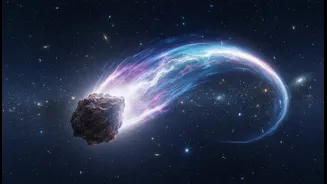
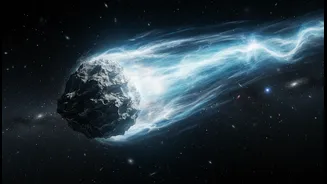
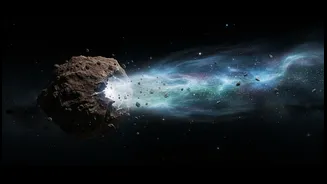
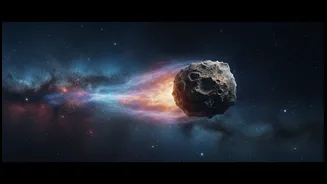
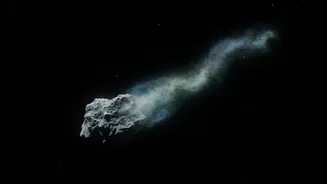
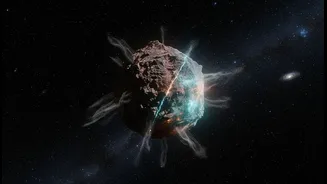
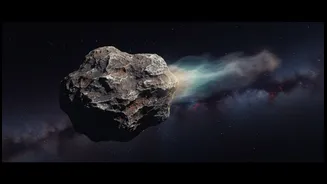
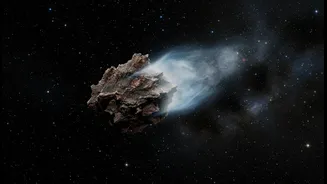
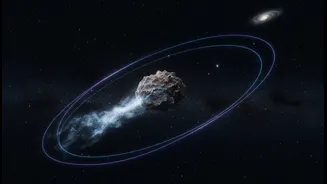
Meet object (248370) 2005 QN173. When it was discovered in 2005, it was classified as just another asteroid—a 3.6-kilometre-wide rock quietly orbiting in the outer part of the main asteroid belt. For years, it behaved exactly as expected. But in July 2021, astronomers using the Asteroid Terrestrial-impact Last Alert System (ATLAS) noticed something astonishing: the asteroid had grown a tail. It looked just like a comet. Further investigation into archival images revealed that it had also shown a tail during a previous close approach to the sun in 2016. This was no one-time fluke, like an impact from another rock kicking up dust. This asteroid was repeatedly coming to life, behaving like a comet every time its 5.3-year orbit brought it near the sun. This recurring activity strongly suggested it was harbouring ice that was turning to gas, just like a comet.
A New Class of Celestial Body
This puzzling object belongs to a rare and fascinating group now known as 'active asteroids' or 'main-belt comets'. These are bodies that have the orbit of an asteroid but display the physical characteristics of a comet. They are challenging long-held scientific assumptions. The first such object, 133P/Elst-Pizarro, was identified in 1996, and since then, only a few dozen have been confirmed out of the millions of known asteroids. The discovery of these hybrid objects is often a joint effort. While automated surveys like ATLAS flag potential candidates, citizen science projects like 'Active Asteroids' have proven invaluable, with thousands of volunteers helping astronomers sift through hundreds of thousands of images to spot the faint signs of activity. This combination of professional and public effort is slowly revealing a solar system that is far more dynamic and less clearly defined than we once believed.
The Real Reason This Matters
So why is a single active asteroid a big deal? The answer is connected to one of the biggest questions in planetary science: Where did Earth's water come from? Our planet is thought to have formed hot and dry. The water that fills our oceans today must have been delivered later, likely by impacts from icy bodies. For a long time, comets from the outer solar system were the primary suspects. However, chemical analysis of many comets shows their water has a different isotopic signature than Earth's water. The discovery of active asteroids—icy bodies orbiting much closer to home in the asteroid belt—provides a compelling alternative. These objects could represent a lost population of water-rich bodies that formed in our cosmic neighbourhood. It's plausible that bodies like 2005 QN173 are the true ancestors of Earth's water, delivering the key ingredient for life billions of years ago.