





First, Let's Define Our Terms
Before we dive into the Venusian weirdness, let’s get our basics straight. A 'year' is the time it takes for a planet to complete one full orbit around its star. This is its orbital period. For Earth, that’s roughly 365 days. A 'day' is a bit more complex.
What we usually mean is a 'solar day'—the time it takes for the Sun to appear in the same position in the sky, like from one noon to the next. But for astronomers, the more precise term is a 'sidereal day', which is the time it takes for a planet to complete one full 360-degree rotation on its axis. On Earth, these two are very close (a sidereal day is about 23 hours and 56 minutes). On Venus, the difference is dramatic and key to the whole puzzle.
Venus by the Numbers
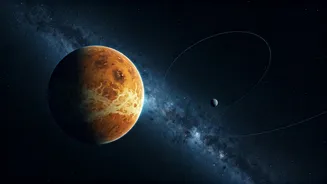
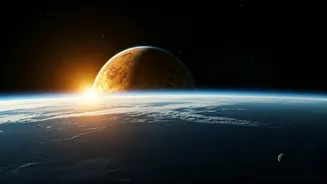
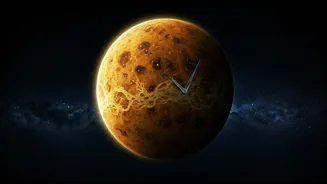
Here's where it gets strange. Venus takes approximately 225 Earth days to complete one orbit around the Sun. So, one Venusian year is 225 Earth days long. However, it takes Venus about 243 Earth days to complete a single axial rotation (a sidereal day). You read that right: it takes longer for the planet to spin once on its axis than it does for it to travel all the way around the Sun. This is the core of the paradox. By this measure, a day on Venus is indeed longer than a year. If you were standing on Venus, you’d complete a full lap around the Sun before the planet beneath you finished a single spin.
The Slow, Backward Spin
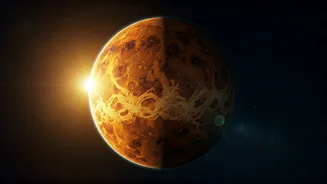
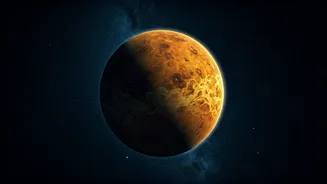
The main reason for this temporal oddity is Venus's incredibly sluggish and backward rotation. Most planets in our solar system, including Earth, rotate counter-clockwise on their axis, the same direction they orbit the Sun. This is called prograde rotation. Venus, however, spins clockwise, a phenomenon known as retrograde rotation. It's not just backward; it's also the slowest rotation of any planet in our solar system. Imagine a spinning top that has been slowed almost to a halt and is barely turning. That’s Venus. This combination of a slow spin in the 'wrong' direction is what sets the stage for its bizarre timekeeping.
A Tale of Two Days
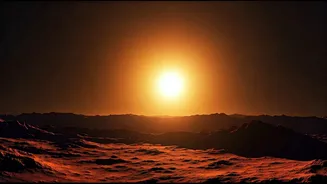
Because Venus rotates backward while orbiting the Sun, its solar day (from sunrise to sunrise) is different from its sidereal day. While the planet takes 243 Earth days to spin once, a sunrise-to-sunrise cycle is 'only' about 117 Earth days long. This is because as Venus slowly rotates backward, its orbit around the Sun means the Sun 'catches up' in the sky much faster. So, while an axial rotation (sidereal day) is longer than a year, a solar day is shorter than a year. This means you would experience roughly two sunrises and sunsets in a single Venusian year. It's a mind-bending concept that completely separates it from our Earthly experience of day and night.
Why is Venus So Strange?
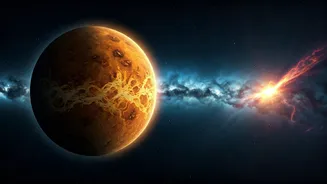
Scientists don't have a single, definitive answer, but there are two leading theories. The first, and most widely accepted, is that early in its history, Venus suffered a colossal impact from a planet-sized object. This cataclysmic event could have been powerful enough to not only halt its original rotation but actually reverse it, leaving it with the slow, retrograde spin we see today. The second theory involves Venus's incredibly thick, heavy atmosphere—over 90 times denser than Earth's. Scientists suggest that powerful atmospheric tides, created by the Sun's immense gravity pulling on this dense blanket of gas, could have acted as a brake over billions of years, slowing Venus's rotation to its current crawl.