



A Sweet Discovery in a Cosmic Cauldron
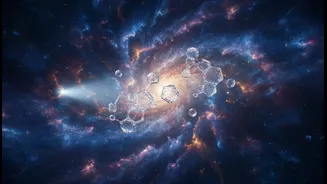
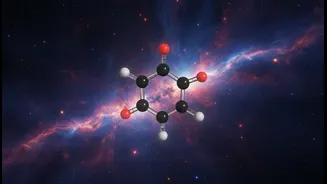
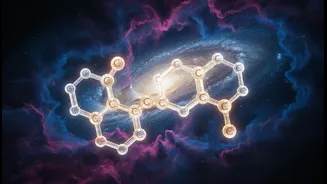
Imagine peering 27,000 light-years away towards the chaotic, star-forming heart of the Milky Way and finding a familiar taste of home. An international team of scientists recently did just that, identifying erythrulose, a four-carbon sugar, within a massive
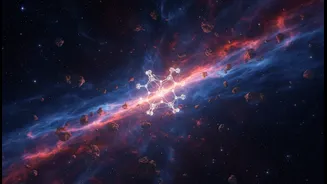
molecular cloud known as G+0.693-0.027. This isn't just a quirky find; it's the first time a true sugar molecule has been definitively detected in the interstellar medium—the cold, diffuse space between stars. While simpler organic molecules have been found before, locating a relatively complex sugar like erythrulose, which on Earth gives raspberries some of their character, suggests that the chemical ingredients for life are far more widespread than previously imagined. The discovery, made using powerful radio telescopes in Spain, confirms that the vast nurseries where stars and planets are born are also acting as cosmic chemical factories.
Solving an Earth-Bound Mystery
For decades, one of the biggest puzzles in understanding the origin of life has been the 'sugar problem'. Sugars are fundamental to life as we know it; they form the structural backbone of RNA and DNA. However, scientific models have struggled to explain how these crucial molecules could have formed in sufficient quantities on the hot, volatile surface of early Earth. The conditions just weren't right. This new discovery provides a compelling solution. If sugars like erythrulose can form in the freezing-cold vacuum of space, they don't need to be created on a planet's surface. Instead, they can be delivered ready-made. Scientists estimate that millions of tonnes of erythrulose could have rained down on a young Earth via comets and asteroids during a period known as the Late Heavy Bombardment, some four billion years ago, seeding our world with the raw materials needed for life to emerge.
A Blueprint for Life's Building Blocks
What makes erythrulose so special is its role as a chemical stepping stone. It serves as a precursor for creating even more complex molecules that are vital for biology. Laboratory experiments have shown that erythrulose can be converted into ribonucleotides, which are the fundamental building blocks of RNA. Many scientists subscribe to the 'RNA World' hypothesis, which posits that RNA, not DNA, was the first genetic material. The presence of an RNA precursor in interstellar clouds provides strong evidence for this theory, suggesting that the journey towards life began long before our planet even fully formed. The finding was also surprising because the four-carbon erythrulose was found in abundance, while simpler three-carbon sugars were absent, challenging the long-held belief that complex molecules are built one carbon atom at a time. Researchers now believe erythrulose may form by combining two smaller, two-carbon molecules that are common in space.
India's Gaze Towards the Cosmos
This discovery highlights the critical role of radio astronomy in uncovering the universe's secrets. While this particular finding came from telescopes in Spain, India is a major player in this scientific field. The nation is home to the Giant Metrewave Radio Telescope (GMRT) near Pune, one of the world's most powerful and sensitive radio telescope arrays at low frequencies. Indian scientists using facilities like GMRT are constantly scanning the skies, searching for faint chemical signals from distant galaxies and molecular clouds. Their work contributes significantly to building a global map of cosmic chemistry. Discoveries like the presence of erythrulose inspire and guide the research conducted here, as astronomers in India and around the world collaborate to piece together the grand narrative of how stardust eventually becomes life.