

The Universe's Greatest Enigma
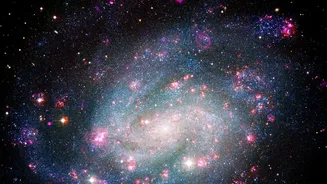
For decades, astronomers believed the universe's expansion, which started with the Big Bang, was slowing down. But in 1998, observations of distant exploding stars, or supernovae, revealed a shocking truth: the expansion is accelerating. To explain this,
scientists proposed the existence of a mysterious, invisible pressure pushing everything apart. This force, which makes up an estimated 68% to 70% of the universe, was named dark energy. Unlike dark matter, which acts as a cosmic glue holding galaxies together, dark energy works as an anti-gravitational force, driving galaxies away from each other at an ever-increasing speed. Understanding its nature isn't just an academic exercise; it's fundamental to knowing how our universe evolved and what its ultimate end might be.
NASA's New Cosmic Detective
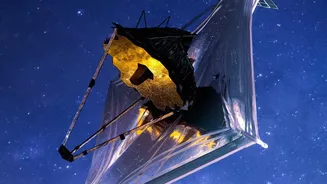
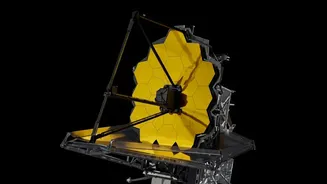
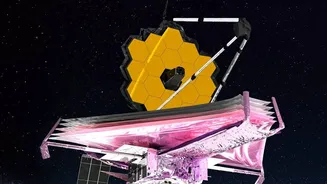
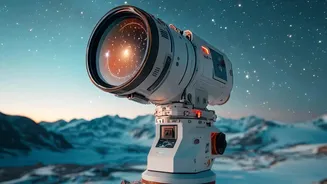
Launched in August 2026, the Nancy Grace Roman Space Telescope is a cutting-edge observatory designed specifically to tackle the dark energy puzzle. Named after NASA's first chief of astronomy, Roman is not just another telescope; it's a cosmic surveyor of unprecedented scale. While observatories like the James Webb Space Telescope study individual objects in extreme detail, Roman's power lies in its incredibly wide field of view. Its Wide-Field Instrument can capture an area of the sky 100 times larger than the Hubble Space Telescope's, allowing it to create enormous cosmic maps in record time. By observing a billion galaxies and thousands of supernovae during its five-year primary mission, Roman will provide a massive dataset to help scientists measure the effects of dark energy across cosmic history.
A Three-Pronged Investigation
To hunt for clues about dark energy, the Roman telescope will employ three distinct but complementary methods. First, it will conduct a massive survey of Type Ia supernovae. These exploding stars have a predictable peak brightness, making them reliable "standard candles" for measuring cosmic distances. By comparing their known brightness to how faint they appear, astronomers can chart the expansion rate of the universe at different points in its history. Second, Roman will study a phenomenon called weak gravitational lensing. This involves measuring how the light from distant galaxies is subtly distorted by the gravity of matter, both visible and dark. These measurements will create a map of how matter is clumped together, revealing how dark energy has influenced the growth of cosmic structures. Finally, the mission will map the large-scale structure of the universe by observing what are known as Baryon Acoustic Oscillations (BAOs). These are giant, frozen ripples from sound waves that rippled through the hot, dense early universe, and they serve as a 'standard ruler' to measure how the universe has expanded over time.
More Than Just a Dark Energy Mission
While unraveling the mystery of dark energy is its primary goal, the Roman Space Telescope's powerful survey capabilities will drive discoveries across many areas of astrophysics. A significant part of its mission is dedicated to exoplanet research. It will use a technique called gravitational microlensing, which can detect planets orbiting stars far from Earth, to perform a census of planets in our galaxy. This will help scientists understand how common different types of planetary systems are. The telescope is also equipped with a coronagraph, an advanced instrument designed to block the blinding light of a star to directly image the faint planets orbiting it. This technology demonstration is 100 to 1,000 times more powerful than previous space-based versions and will be a crucial step toward finding Earth-like worlds in the future.