



A New Cosmic Detective
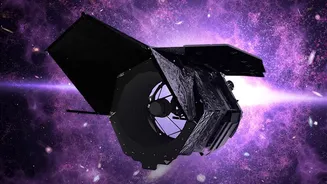
The James Webb Space Telescope (JWST), with its giant golden mirror and unparalleled infrared vision, is more than just a powerful camera; it's a cosmic detective. Launched to peer into the dawn of time, one of its primary missions is to study exoplanets—worlds
orbiting other stars. For decades, scientists have identified thousands of these planets, but knowing they exist is one thing; understanding what they are actually like is another. This is where JWST excels. By capturing the faint light that filters through or is emitted from an exoplanet's atmosphere, the telescope can perform something called spectroscopy. In simple terms, it analyzes the chemical fingerprint of the air on another world, telling us what gases are present. This capability is now providing a sobering, yet crucial, perspective on which of these distant worlds could genuinely support life.
The Case of the Barren Rock
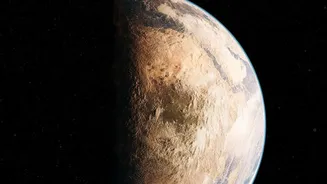
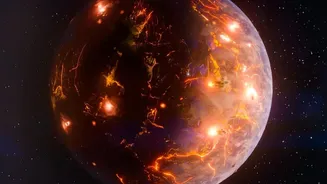
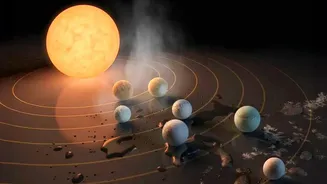
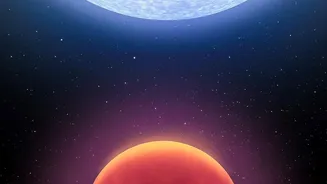
One of the most compelling recent examples comes from observations of planets orbiting red dwarf stars. These smaller, cooler stars are the most common type in our galaxy, and scientists once believed their planetary systems were prime hunting grounds for habitable worlds. However, JWST's gaze is telling a different story. Take the exoplanet GJ 1252 b, located about 65 light-years away. It orbits a red dwarf star and is slightly larger than Earth. By measuring its day-side temperature, astronomers determined it was a scorching 1,200 degrees Celsius. This intense heat strongly suggests the planet has no significant atmosphere to distribute heat from its star-facing side to its night side. Any atmosphere it might have once possessed has likely been stripped away, leaving behind a bare, super-heated rock. This finding is not an isolated incident; similar observations of inner planets in other systems, like the famous TRAPPIST-1 system, are painting a similar picture of atmospheric loss.
How a Star Strips a Planet Bare
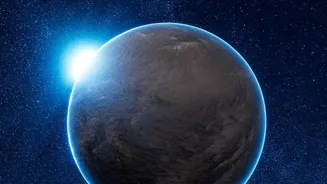
How does a world lose its entire blanket of air? The primary culprit is the very star it calls a parent. While red dwarfs are smaller and dimmer than our Sun, they are notoriously volatile, especially in their youth. They can unleash powerful flares and a constant stream of high-energy radiation. This process, known as atmospheric stripping or photoevaporation, acts like a relentless sandblaster. The intense X-ray and ultraviolet radiation from the star heats the upper layers of a planet's atmosphere, giving gas molecules enough energy to escape the planet's gravitational pull and fly off into space. Over millions of years, this can erode an entire atmosphere, particularly on planets that orbit too closely. JWST's ability to confirm the absence of an atmosphere on planets like GJ 1252 b provides the first direct, observational proof of this theoretical process at work on rocky, Earth-sized worlds.
Redefining the 'Goldilocks' Zone
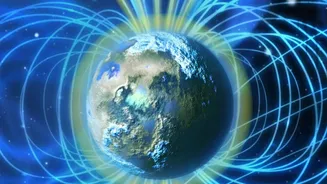
This discovery forces a major rethink of the "habitable zone," often called the "Goldilocks zone." For years, this concept was defined simply as the orbital distance from a star where temperatures are just right—not too hot, not too cold—for liquid water to exist on a planet's surface. But JWST's findings confirm that location isn't everything. A planet can be in the perfect temperature zone, but if its parent star is too active, it won't be able to hold onto the very atmosphere needed to maintain that liquid water and protect potential life from deadly radiation. The true habitable zone, it turns out, is much narrower. It depends not just on distance, but on the star's temperament and the planet's ability to magnetically shield itself and retain its atmosphere over billions of years. This shows that even if a planet is in the habitable zone, an atmosphere is not guaranteed.