








The Spirit of Harela: A Day of Green
Primarily celebrated in the Kumaon region of Uttarakhand, Harela literally means "Day of Green." It marks the arrival of the monsoon, usually falling on July 16, and is deeply rooted in the state's agricultural heritage. The festival, which celebrates
the wedding of Lord Shiva and Goddess Parvati, is a prayer for a bountiful harvest and prosperity. A central ritual involves sowing seven types of grains ten days before the festival. The germination of these seeds is a test of the coming harvest, and the green shoots are shared among family as a blessing. In recent years, this tradition has expanded into large-scale community sapling drives, with the government even declaring a public holiday to encourage mass participation in plantation efforts. This beautifully connects a cultural practice with the urgent, modern need for environmental protection and afforestation.
The Monsoon Advantage for Planting
There is profound ecological wisdom in timing plantation drives with the monsoon, a practice followed for generations across India. The rainy season, from roughly July to September, offers the perfect conditions for a young sapling to establish itself. Consistent rainfall provides natural irrigation, saving effort and ensuring the soil remains moist. This allows the fragile root system of a newly planted tree to penetrate deeper into the earth, establishing a strong anchor before the drier winter and harsh summer months arrive. The cooler, overcast conditions also reduce 'transplant shock'—the stress a plant endures when moved to a new location. With less direct sun and ample water, the sapling can focus its energy on root generation instead of just surviving, dramatically increasing its chances of long-term success.
Beyond Planting: The Critical Aftercare
While planting a sapling is a hopeful and vital act, it is only the beginning. The period following planting, often lasting one to three years, is the most vulnerable phase for a young tree. Most saplings that fail to survive perish during this establishment period. Success is not measured by the number of trees planted, but by how many mature into healthy, adult trees. This is where consistent follow-up care becomes non-negotiable. Without it, even a perfectly timed monsoon planting can fail. Aftercare ensures the tree's fragile root system gets the support it needs to grow strong and deep, making it resilient to future drought, pests, and disease.
A Practical Guide to Sapling Survival
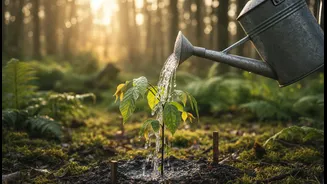
Ensuring your planted sapling thrives is a commitment. First, continue to water it. Even during the monsoon, dry spells can occur. If the soil feels dry a few inches below the surface, the tree needs water. Watering deeply but less frequently is better than a light daily sprinkle, as it encourages deep root growth. Second, apply a layer of organic mulch (like wood chips or dried leaves) in a circle around the sapling, about 2-4 inches deep, but without touching the trunk. This helps retain soil moisture, suppresses weed growth, and keeps the soil cool. Third, protect the sapling. Use a tree guard if there's a risk of damage from animals. If you've used a stake for support, check it regularly to ensure it isn’t choking the growing trunk and remove it after the first year or two once the tree is stable. Finally, avoid pruning heavily in the first year; only remove dead or broken branches. The leaves are the tree's food factory, and it needs all of them to recover from the stress of being transplanted.