






From Launch Day to Lifelong Dream
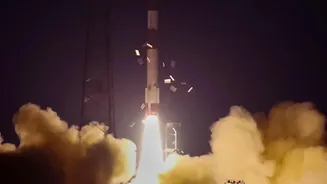
Missions like Chandrayaan and Mangalyaan were more than just scientific endeavours; they were national events. Live-streamed landings were watched in classrooms and city squares, turning complex orbital mechanics into thrilling, edge-of-your-seat drama.
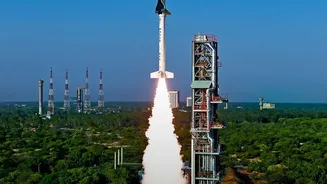
This ability to transform rocket science into a public spectacle has been ISRO's masterstroke. For countless children, watching a rocket ascend from Sriharikota or a rover touch down on the lunar south pole was a formative experience. It wasn't just a satellite reaching orbit; it was a powerful demonstration that anything is possible. This has sparked a surge of curiosity and ambition, with many students openly stating that watching these missions inspired them to pursue careers in space science.
Creating a Direct Path to Space
ISRO doesn't just inspire from a distance; it actively nurtures young talent through dedicated programmes. The most prominent of these is the "Young Scientist Programme," or YUVIKA. This initiative brings school students, with a preference for those from rural areas, to ISRO centres for a two-week residential programme. Here, they get to interact with eminent scientists, participate in hands-on activities, visit labs, and get a real feel for what a career in space technology entails. For its 2026 edition, over 100,000 students registered for just 456 spots, showing the immense demand. Beyond YUVIKA, ISRO runs internship schemes, student project trainee programmes, and online courses through its knowledge portal to build a robust pipeline of future scientists and engineers.
The Ripple Effect on Education
The excitement generated by ISRO's successes has had a tangible effect on India's education landscape. Universities and educational institutions report a growing popularity of courses in aerospace engineering, remote sensing, and other space-related technologies. The success of missions like Chandrayaan-3 is credited with igniting a passion for Science, Technology, Engineering, and Mathematics (STEM) fields among young minds. This has created a virtuous cycle: as demand for these courses rises, institutions are pushed to expand their offerings and collaborate more closely with ISRO, establishing incubation centres and joint research projects. The goal is to prepare students not just for traditional jobs but for the evolving needs of a rapidly commercialising space sector.
Fuelling a New Economic Engine
The students inspired by ISRO a decade ago are now becoming the innovators and entrepreneurs of today. Since India opened its space sector to private participation in 2020, there has been an explosion of space-tech startups. The country is now home to around 450 such companies, working on everything from building launch vehicles to satellite data analytics. Many of these startups were founded by former ISRO scientists, creating a vibrant ecosystem where public-sector experience fuels private-sector innovation. This burgeoning industry, projected to be worth over $40 billion by 2033, represents a new frontier for the Indian economy, creating thousands of high-skilled jobs and positioning India as a major player in the global space market.