






A System of Dark, Slender Bands
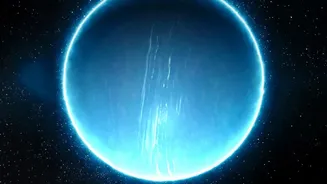
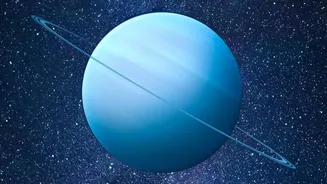
First detected in 1977, the rings of Uranus were a surprising discovery. Unlike Saturn’s broad, bright system, the Uranian rings are incredibly dark and narrow. Most are only a few kilometres wide, a mere thread in the vastness of space. From Earth, they
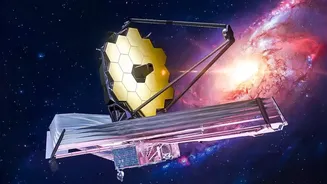
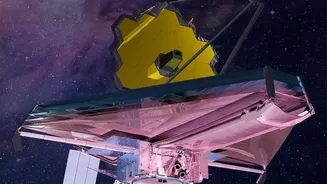
are so faint they were found not by seeing them directly, but by watching them block the light of a distant star. It was NASA’s Voyager 2 spacecraft in 1986, and more recently the James Webb Space Telescope, that gave us our first clear images of this enigmatic system, revealing a complex of 13 distinct rings. Their most striking feature is their colour; the particles that form them are darker than charcoal, reflecting very little sunlight. This deep darkness points directly to a unique chemical makeup, very different from the water-ice-dominated rings of Saturn.
Composition: A Mix of Ice and Dark Organics
So, what are these dark rings made of? Scientists believe they are composed of a mixture of water ice and dark, carbon-rich organic materials. This isn't 'organic' in the biological sense, but rather a term for complex molecules containing carbon. It's thought that methane ice, which is common in the outer solar system, could be a key component. Over millions of years, this ice would be bombarded by radiation from Uranus's magnetosphere, a process that gradually darkens the methane and other compounds, turning them into the soot-like material we observe today. While most of the main rings are composed of these dark, golf ball-sized or larger rocks, there is very little dust. Recent observations, however, have shown that some of the faint outer rings have a different story. The μ (mu) ring, for example, is actually blue and seems to be made of tiny ice particles supplied by the small moon Mab.
The Shepherd Moons' Gravitational Embrace
The extreme narrowness of Uranus's rings was a major puzzle for astronomers. Normally, ring particles should drift apart over time, causing the rings to spread out and dissipate. The solution came with the discovery of 'shepherd moons'. For the brightest and widest ring, the Epsilon ring, Voyager 2 identified two small moons, Cordelia and Ophelia, orbiting on either side of it. These moons, each only about 20-30 kilometres in diameter, act like gravitational sheepdogs. The inner moon, Cordelia, orbits slightly faster than the ring particles, giving them a slight energy boost and pushing them outward. The outer moon, Ophelia, orbits more slowly, taking energy from the particles and nudging them inward. This constant gravitational herding from both sides confines the ring particles into a narrow, well-defined band, preventing them from dispersing. While this mechanism perfectly explains the Epsilon ring, the confinement of other narrow rings that lack obvious shepherds remains an area of active study.
A Young and Violent Origin
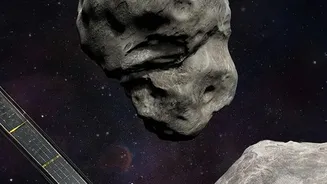
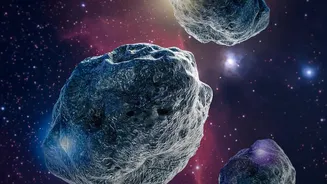
The rings of Uranus are not thought to be primordial features that formed with the planet. Instead, the evidence points to them being relatively young, perhaps no more than 600 million years old. This suggests a much more dramatic origin story. The leading theory is that the rings are the remnants of one or more moons that once orbited Uranus. A catastrophic event, such as a collision between moons or an impact from a large comet or asteroid, could have shattered these bodies into countless fragments. Over time, these fragments would have settled into the stable orbital zones where we now see the narrow, dense rings. This theory explains both the composition and the structure of the system—a chaotic breakup that left behind a delicate, carefully balanced set of cosmic debris, perpetually corralled by the planet's tiny moons.