




Day 1: Arrival in Aurangabad and the Majesty of Ellora
Your journey begins in Aurangabad (now officially Chhatrapati Sambhajinagar), the ideal base for exploring this region's UNESCO World Heritage Sites. After settling in, head to the Ellora Caves, a monumental complex of rock-cut temples and monasteries
just an hour's drive away. Spanning Hindu, Buddhist, and Jain traditions, the 34 caves at Ellora are a testament to religious harmony in ancient India. The undeniable centerpiece is Cave 16, the Kailasa Temple. It's the world's largest single monolithic excavation, a breathtaking structure carved from the top down to represent Lord Shiva's Himalayan abode. Plan to spend several hours here, as the scale and detail are immense.
Day 2: The Painted Narratives of Ajanta
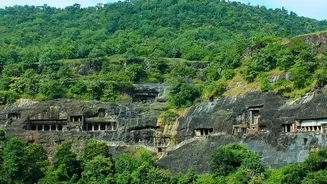
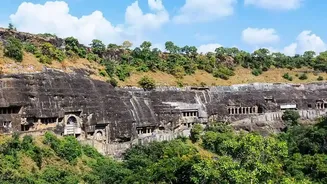
Dedicate your second day to the Ajanta Caves, located about 100 km from Aurangabad. It's best to start early for this full-day excursion. Unlike Ellora, Ajanta is famous for its stunningly preserved murals. The 29 Buddhist caves, carved into a horseshoe-shaped gorge, are filled with paintings that depict the Jataka tales—stories of the Buddha's previous lives. These artworks are considered masterpieces of ancient Indian art. Caves 1, 2, 16, and 17 contain some of the most vibrant and detailed paintings, while Cave 26 features an impressive sculpture of the reclining Buddha. Remember that Ajanta is closed on Mondays, just as Ellora is closed on Tuesdays, so plan your visit accordingly.
Day 3: The Impregnable Daulatabad Fort
On your third day, travel from Aurangabad towards Pune, a drive of about 5-6 hours. Along the way, make a crucial stop at Daulatabad Fort, a medieval fortress perched on a conical hill. Originally known as Devagiri, this fort was renowned for its formidable defences, including a deep moat, multiple gateways, and a labyrinthine dark passage designed to confuse attackers. Climbing the roughly 750 steps to the top is a rewarding challenge, offering panoramic views and a real sense of the fort's strategic genius. Plan for a 2-3 hour visit to fully appreciate this architectural marvel before continuing your journey to Pune.
Day 4: The Lion's Fort - Sinhagad
Now based in Pune, the heartland of the Maratha Empire, it's time to explore the legendary hill forts. Start with Sinhagad, the 'Lion's Fort', located about 35 km from the city. The fort holds immense historical importance, most famously for the Battle of Sinhagad in 1670. It was here that Chhatrapati Shivaji's trusted general, Tanaji Malusare, laid down his life to recapture the fort, prompting Shivaji to remark, 'The fort is won, but the lion is gone'. A trek to the top is popular among locals and offers stunning views of the surrounding Sahyadri ranges. You can see the forts of Rajgad and Torna on a clear day.
Day 5: Rajgad, The Former Maratha Capital
For your final day, visit Rajgad Fort, which served as the capital of the Maratha Empire under Chhatrapati Shivaji Maharaj for nearly 26 years before he moved it to Raigad. Its name translates to 'Royal Fort', a fitting title for a site of such historical weight. The fort is vast and was a place of personal significance for Shivaji; it was here his queen Saibai passed away and his son Rajaram I was born. Exploring its expansive ridges, palaces, and water cisterns provides a profound insight into the strategic and personal life of the Maratha king. It’s a fitting end to a journey through the layers of Maharashtra's powerful history before you depart from Pune.