







The Moon’s Unforgiving Environment
Before we can build cities on the Moon, we have to face a harsh reality: the lunar surface is one of the most hostile environments imaginable. Unlike Earth, the Moon has no significant atmosphere or global magnetic field to protect it. This leaves it completely
exposed to the relentless bombardment of cosmic radiation, dangerous solar flares, and a constant shower of micrometeoroids. Astronauts on the surface would be exposed to radiation levels hundreds of times greater than on Earth, posing serious long-term health risks, including DNA damage and increased cancer risk. Furthermore, surface temperatures swing wildly from a scorching 120°C in the day to a bone-chilling -130°C at night, with some permanently shadowed craters plunging below -240°C. Any surface habitat would require immense, heavy shielding to protect its inhabitants, making long-term settlement a logistical nightmare.
Nature's Underground Shelters
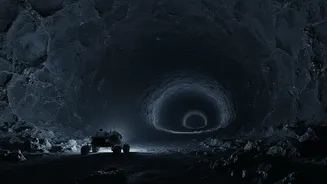
The solution might not be in what we build, but in what we find. Scientists are increasingly confident that the Moon is home to a network of subterranean lava tubes—enormous, hollow caves formed by ancient volcanic activity. These natural tunnels, some potentially large enough to house entire cities, are considered prime candidates for future lunar bases. Hidden beneath tens of meters of solid rock, they offer near-perfect protection from the hazards of the surface. The thick basaltic roof would act as a natural shield, drastically reducing exposure to cosmic and solar radiation to levels that could be comparable to Earth. Studies suggest that once inside a horizontal lava tube, the radiation dose could drop to less than 1 millisievert per year, a value similar to our normal exposure on Earth.
Forged in Fire: How Lava Tubes Are Made
Lunar lava tubes are relics of the Moon's volcanic past, billions of years ago. They formed when rivers of molten lava flowed across the surface. The outer surface of the lava flow would cool and harden when exposed to the cold of space, forming a solid crust. Beneath this insulating roof, the molten lava continued to flow like a river in a channel. When the volcanic eruption eventually ceased, the remaining lava drained away, leaving behind a vast, empty tunnel. On Earth, lava tubes are typically a few meters wide. But thanks to the Moon's lower gravity—just one-sixth of Earth's—lunar lava tubes could be spectacularly large, potentially reaching widths of over a kilometer. Evidence for these structures comes from orbiters, like India's Chandrayaan-1 and NASA's Lunar Reconnaissance Orbiter, which have spotted pits on the surface believed to be 'skylights'—collapsed sections of a lava tube's roof that create a gateway to the cavern below.
A Shield Against the Cosmos
The primary benefit of a lava tube habitat is profound radiation shielding. The rock overburden would effectively block the constant stream of galactic cosmic rays and the intense bursts of radiation from solar flares, protecting both astronauts and sensitive electronic equipment. But the advantages don't stop there. These subterranean havens would also provide complete protection from the constant threat of micrometeoroid impacts. Moreover, they offer a remarkably stable thermal environment. While the surface endures extreme temperature swings, the inside of a lava tube is thought to maintain a steady, chilly temperature of around -20°C. While cold, this constant temperature is far easier and more energy-efficient to manage for a habitat than the violent fluctuations on the surface. The caves would also be a dust-free environment, a significant advantage given that abrasive, toxic lunar dust is a major hazard for both equipment and human health.
The Hunt for Our Future Home
While the promise is enormous, we are still in the early days of exploration. Space agencies like NASA and ISRO are actively working to map these features more accurately. Recent analyses using radar data have provided some of the first direct evidence of an accessible tube extending from a known pit, confirming that these are more than just a theory. The next steps involve robotic exploration. Missions are being proposed to send rovers, and even drones, down into these skylight pits to explore the caves firsthand. These robotic scouts would assess their size, structural stability, and geological makeup, paving the way for future human missions. India's own space ambitions align with this goal, with ISRO having previously identified a potential 1.2 km-long tube using data from its Chandrayaan-1 mission, highlighting its potential for human habitability. These missions are crucial for turning the concept of lava tube living into a concrete engineering plan.