

What Exactly is the SHAPE Experiment?
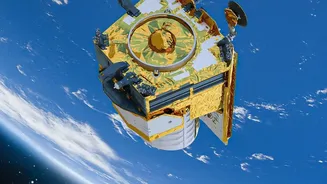
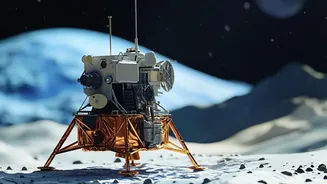
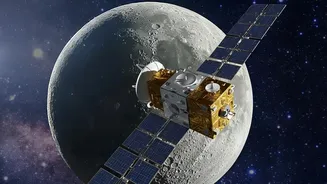
SHAPE, which stands for Spectro-polarimetry of HAbitable Planet Earth, is a specialised scientific instrument. It was the sole experimental payload on the Propulsion Module of the Chandrayaan-3 spacecraft—the part responsible for carrying the Vikram lander
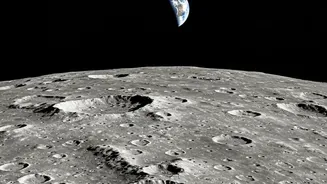
to the lunar orbit. While the lander and rover focused on the Moon's surface, the Propulsion Module continued to orbit, allowing SHAPE to conduct its observations. Designed by scientists at ISRO's U. R. Rao Satellite Centre, its primary job was to study the light reflected from Earth, not as a detailed image, but as a single, integrated point of light, much like how we see distant planets.
Studying Earth to Find Other Earths
The core mission of SHAPE was to treat Earth as a proxy for an exoplanet—a planet outside our solar system. By studying the detailed characteristics of the light from our known habitable world, scientists can create a benchmark. When powerful telescopes like the James Webb Space Telescope look at distant exoplanets, they receive only a tiny speck of light. SHAPE’s data helps scientists understand what 'biosignatures', or signs of life and habitability, look like in that single speck. The key questions it aimed to answer were: what does the combined light spectrum of a life-bearing planet look like, and how does its polarized light signature appear from afar?
The Science of Light and Life
SHAPE uses two key techniques: spectroscopy and polarimetry. Spectroscopy breaks light down into its constituent wavelengths, like a prism creating a rainbow. This reveals the chemical makeup of what the light passed through, such as gases in an atmosphere. Polarimetry, on the other hand, measures the orientation of light waves. When light reflects off clouds, oceans, or land, its polarization changes. By measuring these changes, SHAPE can infer features like cloud cover, which is crucial for determining a planet's climate and potential for liquid water. The instrument specifically looks at the near-infrared wavelength range, which is sensitive to signatures from water vapour and other atmospheric components.
What Has the Data Shown So Far?
The primary result from SHAPE is not a 'discovery' in the traditional sense, but the successful collection of a unique dataset. It has provided the first-ever disc-integrated spectro-polarimetric observations of Earth from a lunar orbit, capturing how our planet's 'light signature' changes as it rotates and as the viewing angle changes. These observations serve as a crucial reference library for future exoplanet studies. Scientists now have a detailed template of a habitable planet's characteristics to compare against observations of distant worlds. The data validates that this method can be used to detect key features related to habitability, like atmospheric gases and cloud cover, even when a planet is just a single point of light.
Why This Unique Vantage Point Matters
Previous studies of Earth's integrated light, known as 'Earthshine', were often done from the ground by observing light reflected from the Moon's dark side. However, these observations can be contaminated by the lunar surface itself. Other missions, like Galileo on its way to Jupiter, also took snapshots of Earth, but SHAPE's sustained observations from a stable lunar orbit offer a more comprehensive and clean dataset over various phases. This unique perspective confirms theoretical models of what an Earth-like exoplanet would look like to a distant observer, moving the science of exoplanet characterisation from theory to practice.