



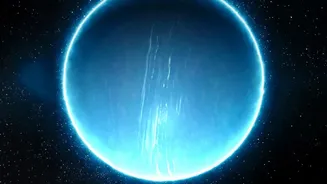

Challenging the Earth-centric View
The concept of a superhabitable planet, first formally proposed in 2014 by scientists René Heller and John Armstrong, challenges our geocentric bias. It asks a simple but profound question: Is Earth the best planet for life, or just one of many possibilities?
The search for extraterrestrial life has long focused on finding planets with Earth's size, mass, and temperature. However, this approach assumes our world offers the optimal conditions. Superhabitability suggests we should look for planets that could support more biomass and greater biodiversity than Earth. This shifts the goal from finding an Earth twin to identifying worlds where life could, theoretically, have an even better chance to emerge and flourish.
The 'Goldilocks' Star
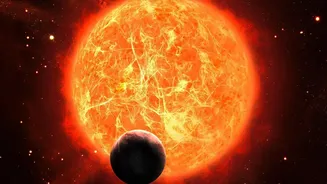
A key factor for a superhabitable planet is its host star. Our Sun is a G-type star with a lifespan of about 10 billion years. While stable, it may not be ideal. Stars more massive than the Sun burn out too quickly for complex life to evolve. On the other end, the most common stars, M-type red dwarfs, are prone to violent flares of radiation that could sterilize a nearby planet. Scientists now believe the sweet spot lies with K-type dwarf stars, often called 'orange dwarfs'. These stars are cooler and less luminous than our sun but have incredibly long lifespans, ranging from 15 to 70 billion years. This extended, stable period could provide a much longer window for life to not just arise, but to evolve in complexity.
Bigger, Warmer, and Wetter
Beyond the star, the planet itself needs specific characteristics. An ideal superhabitable world would likely be slightly larger and more massive than Earth—up to 1.5 times the mass and about 10% larger in radius. A greater mass would mean stronger gravity to hold onto a thicker atmosphere, which could offer better protection from cosmic radiation and help regulate surface temperatures. A slightly larger size provides more surface area for habitats. The ideal temperature would be a few degrees warmer than Earth's average. This, combined with higher humidity, could lead to vast, biologically rich tropical regions, similar to how Earth's rainforests host more than half of its species despite covering a small area. Abundant water distributed across many shallow seas and archipelagos, rather than deep, vast oceans, could also boost biodiversity.
The Importance of Age
For complex life to evolve, time is a critical ingredient. Life on Earth took nearly 4 billion years to produce complex organisms. A superhabitable planet would likely be older than Earth, perhaps in the range of 5.5 to 8 billion years old. This 'golden age' gives a planet more time in a stable environment for life to diversify and become more complex. An older planet orbiting a long-lived K-dwarf star would have an enormous advantage over Earth, which faces the eventual expansion of our Sun into a red giant in a few billion years. Other factors, like a strong magnetic field to shield against stellar winds and active plate tectonics to recycle nutrients, are also considered crucial parts of the superhabitable puzzle.
Are There Any Candidates?
While the concept is well-defined, finding confirmed superhabitable planets is a challenge with current technology. In 2020, a study led by geobiologist Dirk Schulze-Makuch identified 24 potential candidates from the thousands of known exoplanets. These planets, all more than 100 light-years away, meet some of the criteria, though none are a perfect match yet. For example, some are the right size and orbit a K-type star, but their age or atmosphere is unknown. These candidates serve as prime targets for future observation with powerful instruments like the James Webb Space Telescope, which can analyze exoplanet atmospheres for signs of life. The list is not definitive but provides a crucial roadmap, helping astronomers focus their search on the most promising worlds beyond our solar system.