



Sailing on Beams of Light
At its core, a solar sail works much like a sailboat's sail catching the wind. But in the vacuum of space, there is no wind. Instead, solar sails capture the faint but constant pressure of sunlight itself. Sunlight is made of particles called photons
which, despite having no mass, carry momentum. When these photons strike a vast, reflective sail, they transfer their momentum, giving the spacecraft a tiny but continuous push. Over weeks and months, this gentle, unending acceleration allows a spacecraft to reach incredible speeds without carrying heavy, life-limiting chemical propellant. This makes solar sails a cost-effective and long-lasting propulsion system, ideal for deep space missions.
The Navigation Breakthrough: More Than Just a Push
The real breakthrough isn't just propulsion; it's navigation. A solar sail isn't a passive sheet simply being pushed away from the sun. By carefully tilting the sail relative to the sun's rays, mission controllers can steer the spacecraft with incredible precision, much like a sailor tacking into the wind. This ability to 'shape' a trajectory is a game-changer. Instead of the 'point and shoot' nature of a chemical rocket burn, which provides a powerful but short burst of energy, a solar sail offers continuous, low-thrust propulsion. This allows for gradual, fine-tuned adjustments over the entire course of a multi-year journey, enabling complex maneuvers that would be impossible or prohibitively fuel-intensive for a traditional probe.
Why This Matters for Asteroid Missions
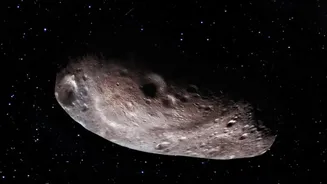
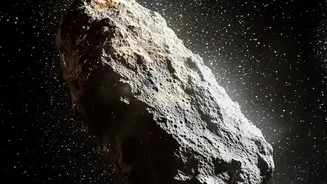
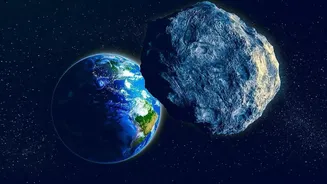
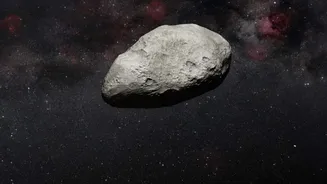
Near-Earth Asteroids (NEAs) are notoriously tricky targets. They are often small, dark, and have uncertain orbits. For a successful rendezvous or flyby, a probe needs to be exceptionally agile. This is where solar sails excel. Missions like NASA's NEA Scout, though it ultimately lost communication after launch, were designed specifically to leverage this technology. The plan was to use the solar sail to perform a series of lunar flybys to gain speed and then embark on a long cruise toward an asteroid. The continuous thrust allows the probe to match the asteroid's velocity for a slow, controlled flyby, providing ideal conditions for taking high-resolution images and collecting scientific data. This reconnaissance is vital for both planetary defense—understanding potential threats to Earth—and for identifying resources for future human exploration.
Precision Interception and the Future
The precision comes from combining the sail's continuous thrust with advanced optical navigation. About a month before reaching its target, a probe like NEA Scout begins its approach phase, using onboard cameras to spot the asteroid against the black of space and refine its trajectory in real-time. This combination allows the spacecraft to arrive at exactly the right place and time. This capability is foundational for future, more ambitious missions. Data from technology demonstrators like the Advanced Composite Solar Sail System (ACS3) is guiding the design of much larger sails. NOAA and NASA are exploring solar sails for space weather satellites, which could provide earlier warnings of solar storms by stationing themselves closer to the sun. Private companies are also getting involved, with Opterus being awarded a NASA contract in April 2026 to develop a massive 1,600-square-meter sail system.
A New Era of Agile Exploration
The evolution of solar sail technology represents a fundamental shift in how we approach space exploration. By eliminating the need for propellant, these systems dramatically reduce mission cost and complexity, especially for small spacecraft like CubeSats. This opens the door for fleets of tiny, low-cost probes to explore thousands of celestial bodies instead of just one. While early missions like Japan's IKAROS and The Planetary Society's LightSail 2 proved the concept, the current generation of technology is focused on refining the precise navigation needed for complex scientific objectives. This breakthrough allows us to not only travel through space on a sunbeam but to steer that journey with unprecedented accuracy, unlocking a new frontier of discovery.