

A Giant Decagon Appears
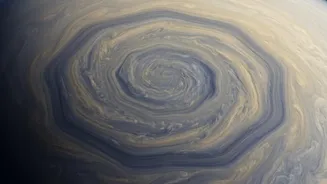
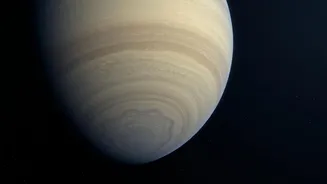
For decades, scientists have been fascinated by a stable, six-sided jet stream, known as the hexagon, at Saturn’s north pole. It was long considered a unique feature. However, new Hubble observations have revealed a stunning counterpart: a massive, 10-sided
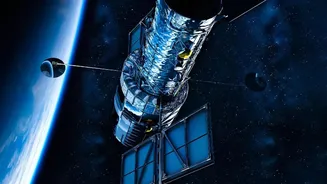
atmospheric wave, or decagon, encircling the south pole. This is the first time a large, regular-sided jet pattern has been seen in the planet's southern hemisphere. The discovery came after Saturn's long, 29-year orbit brought its south pole, which had been hidden from Earth's view since 2012, back into sight for telescopes. Initial signs were spotted by ground-based observatories and amateur astronomers in 2024 before Hubble provided a high-resolution confirmation.
An Evolving Enigma
Unlike the northern hexagon, which has been a stable fixture for over 40 years, this new southern decagon appears to be actively evolving. By analyzing archival Hubble images, scientists have traced its origins back to 2023, when faint hints of the structure began to form. The Cassini spacecraft, which orbited Saturn from 2004 to 2017, saw no evidence of it, suggesting the feature is a recent development. According to NASA scientist Amy Simon, the decagon appears to be strengthening, giving researchers a rare chance to watch a giant atmospheric pattern develop in real-time. This instability and recent formation are what make it a profound mystery.
More Than Just Clouds
This 10-sided feature is not just a superficial pattern in the top layer of clouds. Observations show that the wave extends deep into Saturn's atmosphere, persisting through several layers. It is a massive, vertical wall of wind embedded within one of Saturn's powerful jet streams, with winds measured at around 400 kilometers per hour. The decagon itself migrates slowly eastward, unlike the largely stationary northern hexagon. Scientists believe that jet streams naturally flow in circular patterns; for a polygon to form, some other force must be at play, possibly the interaction with an adjacent vortex. The discovery challenges the long-held belief that the north pole's hexagon was an anomaly.
What Happens Next?
The discovery of the decagon opens up a new chapter in our understanding of planetary atmospheres. Scientists are now eager to see how the structure evolves, especially as Saturn's southern hemisphere tilts further toward the sun, heading for its summer in 2032. The increased solar energy could either stabilize the decagon into a permanent feature like its northern counterpart, or it could tear the unstable structure apart. Continued observations from Hubble, the James Webb Space Telescope, and ground-based observatories will be crucial. Studying how these giant geometric storms form on gas giants provides a real-world laboratory for testing the complex models of fluid dynamics that help us understand weather on planets across the universe, including our own.