



So, What Is Quantum Communication?
Forget everything you know about traditional data transmission. At its core, quantum communication uses the strange and wonderful laws of physics to send information. Instead of encoding data in radio waves, it uses individual particles of light, called
photons. Think of it as sending a secret message one letter at a time, with each letter carried by its own microscopic messenger. India, through its National Quantum Mission, is betting big on this technology, dedicating over ₹6,000 crore (around $720 million) to develop capabilities in quantum computing, sensing, and, crucially, communication. The goal is to build a new generation of secure infrastructure that is immune to the threats of tomorrow.
The 'Unhackable' Promise of QKD
The magic behind this security is a technique called Quantum Key Distribution (QKD). Current encryption relies on complex math problems that, in theory, a powerful enough computer could one day solve. QKD’s security, however, is based on the laws of physics. Here’s a simple analogy: imagine you’re sending a secret key to a friend using photons. If an eavesdropper tries to intercept and measure these photons, the very act of observing them changes their quantum state. This disturbance instantly alerts both the sender and the receiver that someone is listening in, and they can discard the compromised key. It’s like having a built-in alarm system that goes off the moment a spy tries to peek. This makes the key exchange 'information-theoretically secure'—unbreakable not just by today's supercomputers, but by any future computer, no matter how powerful.
India’s Quantum Leap into Space
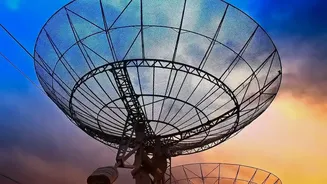
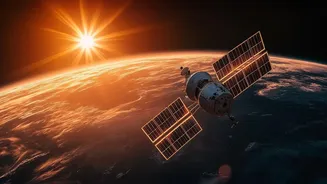
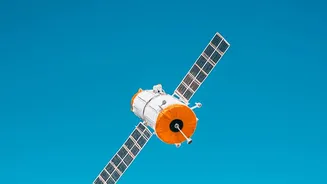
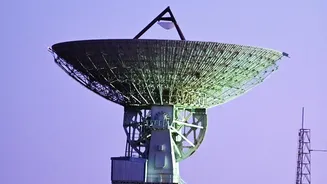
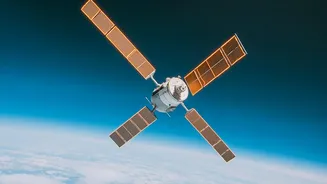
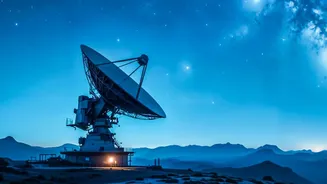
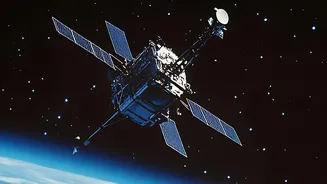
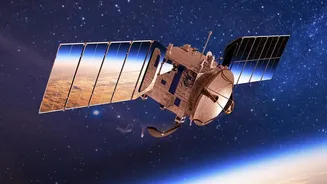
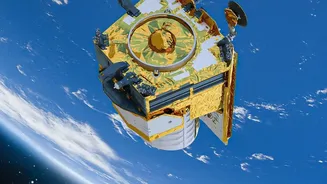
While the theory is sound, putting it into practice is a monumental challenge. The Indian Space Research Organisation (ISRO) has already achieved major milestones. Scientists have successfully demonstrated QKD over a distance of 300 meters on the ground, even using it for a live, quantum-encrypted videoconference. This was a critical proof-of-concept. Now, the ambition is to take it to space. The National Quantum Mission explicitly aims to establish satellite-based quantum communication between ground stations over 2,000 kilometers apart. This would allow for secure links across the vast Indian subcontinent, connecting military assets, government agencies, and critical financial infrastructure without the physical limitations of fiber optic cables.
A New Global Race Heats Up
India isn't developing this technology in a vacuum. A new global quantum race, often compared to the space race or the current push for AI dominance, is well underway. China is a major player, having launched the world's first quantum satellite, Micius, back in 2016 and using it to conduct the first-ever intercontinental quantum-secured video call. The United States, meanwhile, is heavily invested in a different but related approach called post-quantum cryptography (PQC), which focuses on developing new mathematical algorithms that are resistant to quantum computers. By pursuing satellite-based QKD, India is not just aiming for technological self-reliance but also positioning itself as a key player in a field that will define national security and economic power for decades to come.