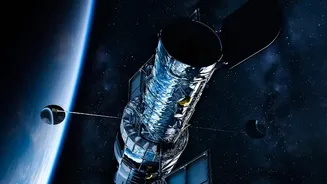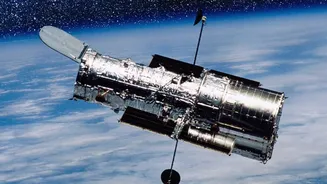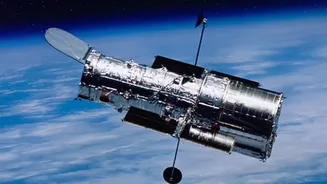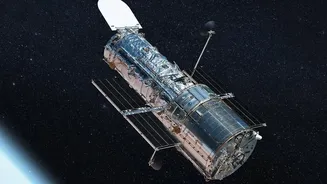





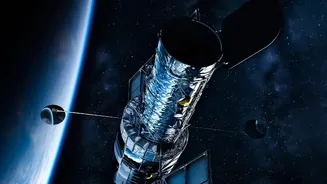

For over three decades, the Hubble Space Telescope has been humanity’s eye on the cosmos, delivering breathtaking images and revolutionary science. But its time may be running out as its orbit decays. Now, NASA has an unconventional plan to save it.
A Jewel in the Sky, Slowly Falling
Since
its launch in 1990, the Hubble Space Telescope has made more than 1.7 million observations, contributing to thousands of scientific papers that have fundamentally changed our understanding of the universe. It was designed to be serviced in space, and five Space Shuttle missions did just that, repairing and upgrading the observatory to keep it at the cutting edge of science. The final servicing mission was in 2009. With the shuttle fleet now retired, Hubble has no way to receive another upgrade or, more critically, a push into a higher orbit. Like all objects in low Earth orbit, Hubble experiences faint atmospheric drag, causing it to slowly lose altitude. Originally deployed at an altitude of about 612 kilometers, it has now dipped well below 500 kilometers. Without a boost, NASA projects the telescope will make an uncontrolled reentry into Earth's atmosphere sometime between 2033 and 2034.
NASA's Call for Commercial Help
Faced with the eventual loss of a multi-billion dollar scientific asset, NASA has turned to the burgeoning private space industry. In late October 2026, the agency issued a formal Request for Information (RFI), asking commercial companies for their ideas on how to address Hubble's predicament. This isn't a typical government contract. Instead, it’s a market survey to gauge what is technically possible and financially viable. The RFI outlines three potential missions: boost Hubble to a higher, more stable orbit of at least 600 kilometers; service the telescope with new components to enhance its capabilities; or perform a safe, controlled de-orbit to ensure it doesn't pose a risk when it comes down. The provider would be responsible for the launch, the spacecraft, and mission operations, including crew if the mission calls for it.
Who Could Answer the Call?
While the RFI is open to any company, one potential partnership has been studied before. In 2022, NASA and SpaceX signed an agreement to study the feasibility of using a Dragon spacecraft to visit Hubble. That effort was part of the Polaris Program, a private human spaceflight initiative led by billionaire and now-NASA Administrator Jared Isaacman. The initial study concluded but did not immediately lead to a mission. Now, with NASA formally soliciting ideas from the entire industry, a crewed mission using a Dragon capsule remains a leading concept. A successful reboost could add 15 to 25 years of life to the mission. The scientific value of this extension is immense, as Hubble's capabilities in visible and ultraviolet light are unique and complement the infrared vision of the newer James Webb Space Telescope.
A New Model for Space Operations
This initiative represents more than just a repair mission; it’s a potential turning point for how space assets are managed. If a private company can successfully and cost-effectively extend the life of Hubble, it could create a new business model for servicing other valuable satellites, both government and commercial. In a statement, NASA leadership emphasized the duty to explore innovative and cost-effective ways to preserve assets already in orbit. The challenge, however, is significant. Any mission would need to safely rendezvous with and capture a delicate, aging telescope that was not designed for modern robotic or commercial docking systems. The risks are high, but the reward is not just more groundbreaking science from Hubble; it’s the dawn of a new, more sustainable and collaborative era in space exploration.