

Lower back strain is one of the most common complaints, often stemming from prolonged sitting and poor posture. Thankfully, gentle movement can offer significant relief. Yoga provides a safe, effective way to decompress the spine and ease tension.
Child's Pose (Balasana)
Child's
Pose is a deeply restorative posture that provides an active, gentle stretch for the entire back, particularly the lumbar region. It helps to elongate the spine, creating space between the vertebrae and relieving the compression that builds up from daily life. To begin, kneel on the floor, touching your big toes together and sitting back on your heels. Separate your knees about as wide as your hips. On an exhale, fold forward, laying your torso down between your thighs. Allow your forehead to rest on the floor as you extend your arms forward or rest them alongside your body. Focus on breathing deeply into your back, feeling the muscles expand and release with each breath. This pose not only eases physical tension but also calms the nervous system, making it an excellent de-stressor.
Cat-Cow Stretch (Marjaryasana-Bitilasana)
This dynamic sequence is a staple in many physical therapy and yoga routines for its ability to gently mobilize the spine. The movement increases flexibility, improves posture, and encourages blood flow to the discs between your vertebrae. Start on your hands and knees in a tabletop position, with your wrists aligned under your shoulders and your knees under your hips. As you inhale (Cow Pose), drop your belly towards the mat, lifting your chest and tailbone to create an arch in your back. As you exhale (Cat Pose), round your spine toward the ceiling, tucking your chin to your chest and drawing your navel in. Flow between these two poses for about a minute, synchronizing the movement with your breath to warm up the spine and release stiffness.
Sphinx Pose (Salamba Bhujangasana)
Sphinx Pose is a gentle backbend that helps restore the natural curve of the lower back, counteracting the effects of slouching. It strengthens the spine without putting excessive pressure on it, making it a safer alternative to deeper backbends like Cobra Pose. To practice this pose, lie on your stomach with your legs extended behind you. Place your elbows directly under your shoulders with your forearms flat on the floor, parallel to each other. Gently lift your head and chest off the floor, pressing your hips and thighs into the mat to create a mild stretch in your lower back. Keep your shoulders relaxed and away from your ears. Hold for 30 to 60 seconds, breathing steadily.
Supine Spinal Twist (Supta Matsyendrasana)
This reclining twist is fantastic for decompressing the vertebrae and stretching the muscles along the sides of your spine and your glutes. It can be particularly effective for relieving stiffness that comes from sitting for long periods. Lie on your back and hug both knees into your chest. Extend your arms out to the sides in a 'T' shape, keeping your shoulders flat against the floor. As you exhale, slowly drop both knees to your left side. You can turn your head to the right to deepen the stretch. The key is to keep both shoulders grounded, even if your knees don't touch the floor. Hold for 30 to 60 seconds before returning to the center and repeating on the other side.
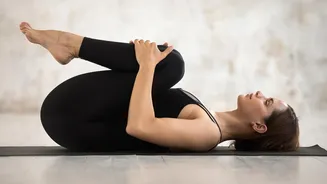
Knee_to_Chest Pose (Apanasana)
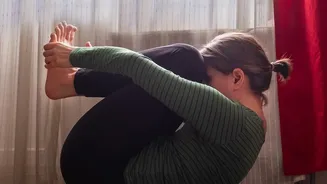
A simple yet powerful pose, the Knee_to_Chest stretch directly targets and releases tension in the lower back and sacrum. It gently decompresses the base of the spine. Lie on your back with your knees bent and feet flat on the floor. Draw your right knee toward your chest, holding onto your shin or the back of your thigh. Gently pull the knee closer while keeping your lower back pressed into the mat. Hold for at least 30 seconds. For an added massage, you can gently rock from side to side. Release and repeat with the left leg. You can also perform this pose by hugging both knees to your chest at any time.