


The Grand Approach to Opposition
The primary reason for Saturn’s popularity in late summer is its journey toward opposition. In 2026, Saturn’s opposition falls on October 4th, but the weeks leading up to it, including all of August, are prime viewing time. Opposition is a simple celestial
alignment where Earth passes directly between the Sun and an outer planet like Saturn. Imagine the Sun, Earth, and Saturn forming a straight line in space. This geometry means that as the Sun sets in the west, Saturn rises in the east, remaining visible all night long. For astronomers, this provides a generous, dark window to observe the planet at its peak.
Brighter, Bolder, and Closer
The opposition alignment doesn't just make Saturn convenient to view; it makes for a better view. During this period, the planet is at its closest point to Earth in its orbit, this year at a distance of about 1.26 billion kilometres. This proximity, combined with its face being fully illuminated by the sun from our perspective, makes Saturn appear larger and brighter than at any other time of the year. Throughout August, you can watch it steadily brighten as it heads toward its peak magnitude. To the naked eye, it will shine as a brilliant, steady golden point of light, easily distinguishable from the twinkling of distant stars.
The Glorious Return of the Rings
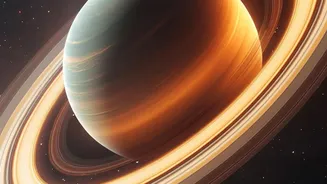
What makes 2026 particularly special is the view of Saturn’s famous rings. In March 2025, the rings were tilted almost perfectly edge-on to us, making them practically disappear for observers with small telescopes. Such a 'ring plane crossing' happens only once every 13 to 15 years. Now, the rings are tilting back into view. By August and through its October opposition, the rings will be angled at about 7.5 degrees toward us. While not their maximum tilt, this is more than enough to provide the breathtaking, three-dimensional view that makes Saturn an unforgettable sight. Even a small telescope will clearly show the rings as a distinct structure separate from the planet’s globe.
What to Look For This Month
You don't need professional equipment to enjoy the show. With just your eyes, you can spot Saturn as a bright, yellowish 'star'. With a good pair of binoculars, you might detect its oval shape or even its largest moon, Titan, appearing as a tiny star-like point nearby. A small telescope with at least 50mm to 75mm aperture is where the magic happens, clearly revealing the rings. With a 4-inch or larger telescope and steady atmospheric conditions, you may be able to spot the Cassini Division—a dark gap between the main A and B rings—and even faint cloud bands on the planet itself.
Tips for the Perfect Viewing
To make the most of your Saturn-gazing, try to get away from bright city lights. While Saturn is bright enough to cut through some light pollution, a darker sky reveals more detail and makes the experience more immersive. Throughout August, Saturn will be rising earlier each night, making it easier to spot in the late evening in the southeastern sky. Use a stargazing app to pinpoint its exact location in the constellation Cetus. Patience is key; allow your eyes to adapt to the dark for at least 15 minutes. Also, wait for moments of still air, as this is when the image in a telescope will suddenly sharpen, revealing incredible detail.