


A New Set of Eyes on the Universe
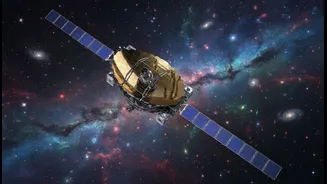
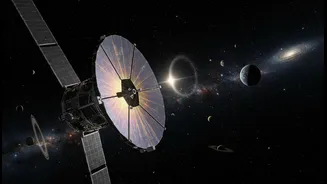
Scheduled for launch around August 30, 2026, the Nancy Grace Roman Space Telescope is NASA's next-generation observatory designed to tackle some of the biggest questions in astrophysics. Named after NASA's first chief of astronomy, the telescope has a 2.4-meter
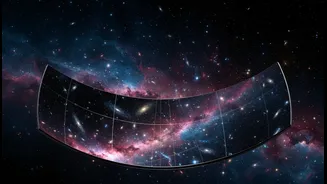
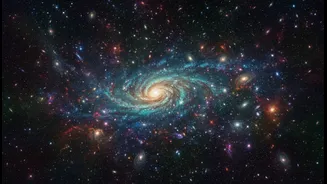
primary mirror, the same size as Hubble's, but with a crucial difference. Its Wide-Field Instrument (WFI) will provide a field of view at least 100 times larger than that of Hubble or the James Webb Space Telescope (JWST). This means that while Hubble might capture a few thousand galaxies in a deep-field image, a similar observation from Roman could reveal millions. Its main goals are to investigate the mysteries of dark energy and dark matter, discover thousands of new exoplanets, and create vast, high-resolution panoramas of the universe.
The Coming Data Tsunami
Roman's immense field of view is what transforms it from a traditional telescope into a data-generating powerhouse. While Hubble has produced around 400 terabytes of data over more than three decades, Roman is projected to generate about 1.4 terabytes every single day. Over its five-year primary mission, it could produce more than 2,500 terabytes of information. To put that in perspective, Roman will generate in less than a year what it took Hubble 30 years to accumulate. This is not just an incremental increase; it's a fundamental shift in the scale of astronomical observation. The sheer volume comes from its ability to rapidly survey huge sections of the sky with incredible detail, essentially creating a high-definition movie of the cosmos rather than just a series of snapshots.
Beyond Pretty Pictures
While the first images will undoubtedly be breathtaking, the true scientific breakthroughs will come from analyzing the enormous datasets that follow. The mission is designed to enable 'big data' astronomy, where discoveries are mined from massive archives. For instance, its Galactic Bulge Time-Domain Survey will monitor hundreds of millions of stars to detect the subtle dimming caused by orbiting exoplanets through a technique called gravitational microlensing. This survey alone is expected to find thousands of new worlds. Likewise, by mapping the distribution of over a billion galaxies, scientists will be able to trace the influence of dark energy on the expansion of the universe over cosmic time. These discoveries require statistical power that only a survey of Roman's scale can provide.
A New Era for Astronomers
This flood of data presents both an opportunity and a challenge. It will be impossible for astronomers to analyze Roman's data using traditional methods on personal computers. Recognizing this, NASA and its partners like the Space Telescope Science Institute (STScI) have developed new, cloud-based platforms. The Roman Research Nexus is a science ecosystem designed to give researchers access to data processing tools, tutorials, and the computational power needed to work with petabyte-scale datasets. This will require a new skill set for many astronomers, blending traditional astrophysics with data science, machine learning, and artificial intelligence to sift through the noise and find faint signals of new phenomena. The data, all of which will be publicly available with no proprietary period, is expected to fuel astronomical research for decades.