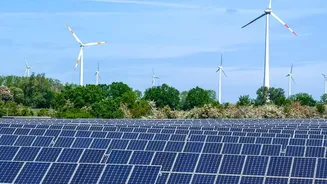







As India balances its vast energy needs with the finite nature of its land, a clever solution is rapidly gaining ground. Solar farming offers a way to generate clean power while optimising land use, and states are taking notice.
More Than Just Panels in a Field
Solar farming, in its simplest
form, involves installing large arrays of ground-mounted solar panels to generate electricity at a utility scale. These projects, often called solar parks, can range from a few megawatts to several gigawatts, like the massive Bhadla Solar Park in Rajasthan which spans over 14,000 acres. However, the concept is evolving beyond just dedicating land exclusively for energy. The real innovation driving momentum is the focus on land efficiency. This includes placing solar farms on barren, non-arable land that is unsuitable for traditional agriculture, thereby generating economic value from otherwise unproductive areas. Another, more advanced, approach is agrivoltaics.
The Rise of 'One Field, Two Harvests'
Agrivoltaics, or Agri-PV, is a game-changer for a country where agricultural land is precious. This model involves co-locating agricultural activities and solar power generation on the same piece of land. Panels are typically mounted on tall structures, high enough for crops to grow underneath and for farm machinery to pass through. This dual-use model allows farmers to continue cultivating their land while earning a second stream of income from selling electricity to the grid. In some cases, the partial shade from the panels can even be beneficial, protecting certain crops from extreme heat and reducing water evaporation from the soil. Recognizing this potential, the central government is actively working on a policy to promote agrivoltaics, which could become a key component of the upcoming PM-KUSUM 2.0 scheme.
States Leading the Solar Charge
The push for solar farming isn't uniform; certain states have emerged as clear leaders, driven by favourable policies and abundant sunshine. Rajasthan leads the country in installed solar capacity, leveraging its vast desert landscapes to host some of the world's largest solar parks. Gujarat is another pioneer, with significant capacity and a strong focus on both large-scale parks and rooftop solar. Karnataka also boasts impressive solar infrastructure, including the 2,050 MW Pavagada Solar Park. These states, along with others like Maharashtra and Madhya Pradesh, have been identified as having high potential for expanding solar projects, especially agrivoltaics, due to their large agricultural areas and favourable solar resources. Recently, Odisha announced its intention to launch a dedicated agrivoltaics policy, the first of its kind in India, aiming for 1 GW of capacity by 2030.
The Policy and Economic Push
Several factors are fuelling this nationwide momentum. The Pradhan Mantri Kisan Urja Suraksha evam Utthaan Mahabhiyaan (PM_KUSUM) scheme has been a critical driver. It provides financial assistance to farmers for installing standalone solar pumps, solarising existing grid_connected pumps, and setting up small solar power plants on their land. This helps farmers reduce their dependence on expensive diesel and unreliable grid power for irrigation. Furthermore, India's ambitious renewable energy targets and the falling cost of solar technology have made solar farming an increasingly attractive economic proposition for both developers and state governments. It provides a predictable, long_term source of revenue through power purchase agreements (PPAs) with distribution companies.
Navigating the Challenges
Despite the clear benefits, the path to widespread solar farming is not without obstacles. Land acquisition remains a major hurdle for utility_scale projects, often leading to conflicts over competing land uses. A 2022 study noted that a significant portion of existing solar projects were built on land that had agricultural or ecological value, highlighting the need for careful site selection. The initial capital cost of setting up a solar farm, particularly an agrivoltaics system which can be 25% more expensive than ground_mounted solar, is a significant barrier for individual farmers. Ensuring that the expansion of solar energy doesn't negatively impact local biodiversity or groundwater levels also requires careful planning and regulation.