
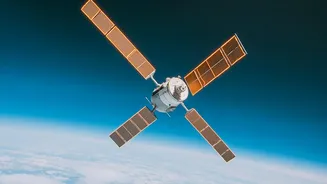
The Challenge with Conventional Satellites
For decades, satellites have navigated the vacuum of space using conventional chemical thrusters. These engines work by burning liquid fuel, much like a rocket, to produce short, powerful bursts of thrust. This method is effective for making large orbital
manoeuvres quickly. However, it comes with a significant drawback: weight. Chemical propellants are heavy, and a large portion of a satellite's launch mass is dedicated just to carrying its own fuel. This mass budget comes at a cost, as it limits the amount of scientific or commercial equipment—like communication transponders or high-resolution cameras—that can be placed on board. Furthermore, a satellite's operational lifespan is often dictated by how much fuel it has for station-keeping, which are the small adjustments needed to maintain a precise orbit. Once the fuel runs out, the multi-crore satellite effectively becomes space debris, even if its electronic systems are perfectly functional.
Enter Electric Propulsion
ISRO's solution is to pivot to a futuristic technology known as electric propulsion, specifically using Stationary Plasma Thrusters (SPTs), a type of Hall-effect thruster. Instead of burning chemicals, these thrusters use electricity, typically generated by the satellite's solar panels, to create and accelerate a stream of plasma. An inert gas like xenon is injected into a chamber where it is ionised, stripping electrons from the atoms to create a plasma. An electric field then ejects these charged ions at extremely high speeds—up to 100 kilometres per second. While the thrust produced at any given moment is very gentle, often compared to the force of a sheet of paper resting on your hand, it is incredibly efficient. Over time, this continuous, gentle push can achieve the same results as chemical thrusters but with a fraction of the fuel.
The 'Less is More' Advantage
The primary benefit of plasma thrusters is their remarkable fuel economy. The specific impulse, a measure of a propulsion system's efficiency, of ISRO's new electric propulsion system is at least six times greater than that of conventional chemical systems. This means a satellite equipped with plasma thrusters needs to carry significantly less propellant to perform its mission. This weight saving has a cascading effect on the entire mission. A lighter satellite is cheaper to launch, or alternatively, the saved mass can be reallocated to the payload. For a communication satellite, this means adding more transponders, which directly translates to higher data capacity and increased revenue. For an Earth observation satellite, it could mean adding more advanced sensors for better imaging. Essentially, ISRO can pack the power of a traditional four-ton satellite into a much lighter frame.
A New Lease on Life in Orbit
Besides the weight savings, the other game-changing benefit is a massively extended mission life. Satellites in geostationary orbit, about 36,000 kilometres above Earth, must constantly fight against gravitational pulls from the Sun and Moon that try to nudge them out of position. These station-keeping manoeuvres are what consume the bulk of a satellite's fuel over its lifetime. Because plasma thrusters sip their xenon propellant so slowly compared to the gulping of chemical engines, they can perform these orbital corrections for a much longer period. A mission that might have been designed for 10-12 years with chemical thrusters could potentially last for 15 years or more. This longevity makes India's satellite constellations more sustainable and economically viable, providing a better return on investment for each launch.
A Strategic Leap for India
ISRO has been diligently working on this technology, moving from using imported components to developing a fully indigenous system. The agency has successfully completed long-duration tests of its 300 millinewton (mN) thruster, proving its reliability for space operations. The plan is to validate this system in an upcoming Technology Demonstration Satellite (TDS-01), which will use electric propulsion for orbit raising. This isn't just a technical upgrade; it's a strategic move that enhances India's competitiveness in the global space market. As the world moves towards large satellite constellations for services like global internet and continuous Earth monitoring, having efficient, long-lasting, and cost-effective satellites is crucial. This technology ensures that ISRO remains at the forefront of space innovation, capable of building more powerful and economical systems for communication, navigation, and science.