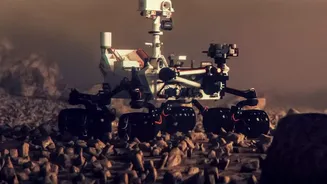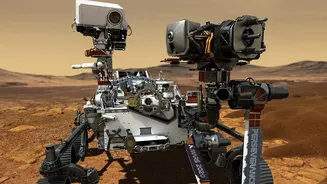








NASA's Perseverance rover has collected priceless Martian rocks, but getting them home is proving much harder than expected. Now, a major strategic review is reshaping one of the most ambitious space missions ever attempted.
The Ultimate Souvenir Hunt
For years, bringing a piece
of Mars back to Earth has been a top priority for scientists. The Mars Sample Return (MSR) campaign, a joint effort between NASA and the European Space Agency (ESA), is designed to do just that. The first phase is already a success: since landing in 2021, the Perseverance rover has been diligently exploring Jezero Crater, an ancient lakebed that may hold signs of past life. It has been drilling into promising rocks, sealing the core samples in ultra-clean tubes, and either storing them on board or dropping them at a designated depot on the surface. The original plan was a complex, multi-part relay race involving a second lander, a small 'fetch' rover to collect the tubes, and a rocket to launch the samples into Mars orbit, where another spacecraft would capture them for the long journey home.
An Ambitious Plan Hits Reality
The MSR mission is arguably the most complex robotic endeavor ever conceived. It involves numerous firsts: landing a large retrieval spacecraft, remotely transferring samples, and launching a rocket from the surface of another planet. As the design matured, its complexity and cost ballooned. Independent reviews revealed that the initial budget was severely underestimated, with the price tag soaring from around $5 billion to a potential $11 billion. The timeline also slipped, with a return date pushed back to 2040 in one assessment. NASA leadership deemed this schedule and cost unacceptable, leading to a pause in the program in late 2023 and a call for a smarter, more achievable approach.
Enter the PSRA Strategy
In response to these challenges, NASA announced a new initiative on November 9, 2026: the Perseverance Sample Retrieval Architecture, or PSRA. This isn't a new mission, but a strategic review tasked with finding a more streamlined and affordable way to get the job done. Announced by the director of NASA's Mars Exploration Program, the PSRA team will develop 'impartial recommendations' for retrieving the samples. Their job is to review all the lessons learned, assess current technology, and propose a viable architecture. The team is set to kick off its work in January 2027, with a final report expected by the winter of 2027-2028.
What Are the New Options?
While the PSRA team's final recommendations are still a year away, the focus is clearly on simplification and cost reduction. Previous appraisals have suggested that a retooled mission could potentially return the samples by 2035 for around $8 billion. This might involve changes like relying on the long lived Perseverance rover to deliver samples directly to the ascent vehicle, eliminating the need for a separate fetch rover. The goal is to create a plan that is scientifically compelling but also fiscally responsible and can be executed in a reasonable timeframe. The urgency is heightened by international developments, as China is also making progress on its own Mars sample return mission, Tianwen -3, which aims to launch around 2028 and return samples by 2031.
Why These Rocks Are Worth the Wait
Despite the logistical and financial hurdles, the scientific community remains adamant that bringing these specific samples to Earth is a revolutionary goal. The samples collected by Perseverance from Jezero Crater are a curated collection of Martian history, including igneous rocks formed deep in the crust and sedimentary rocks that could preserve organic molecules or even biosignatures. Analyzing them in advanced laboratories on Earth will allow for investigations far beyond the capabilities of any rover. These tiny pieces of Mars could unlock fundamental secrets about the planet's geological evolution, its past climate, the history of water, and the ultimate question of whether life has ever existed beyond Earth.