
The Cosmic Data Bottleneck
For decades, space missions have relied on radio waves to send information back to Earth. This method has been a workhorse, bringing us iconic images from the Moon, Mars, and beyond. However, as our scientific instruments become more powerful, capturing
incredibly detailed, high-resolution data and video, radio frequency (RF) systems are hitting a wall. The amount of data we can now generate in space far exceeds our ability to send it home efficiently. Transmitting a full, high-resolution map of Mars with current RF technology could take as long as nine weeks. This data bottleneck limits the pace of discovery and our ability to react to events in real-time, creating a need for a much faster, more robust communications highway.
A Leap to Light Speed
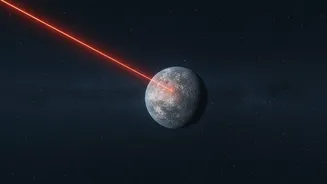
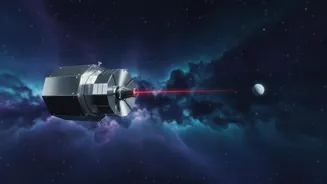
Enter optical communications, more commonly known as laser communications. Instead of encoding data onto radio waves, this technology uses invisible infrared light. The key advantage lies in the physics of light itself. Laser light has a much shorter wavelength than radio waves, which means it can pack significantly more data into a single transmission. Think of it like upgrading from an old dial-up modem to a fiber-optic internet connection. The result is a massive increase in bandwidth, with data rates 10 to 100 times faster than the most advanced RF systems used by space missions today. This leap forward opens the door to streaming high-definition video from deep space and downloading massive scientific datasets in a fraction of the time.
How It Actually Works
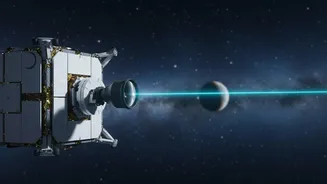
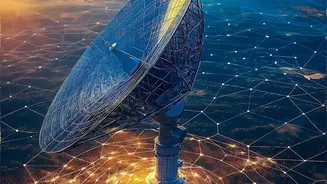
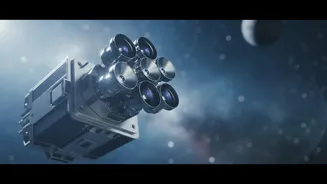
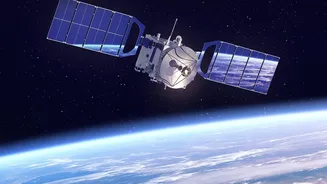
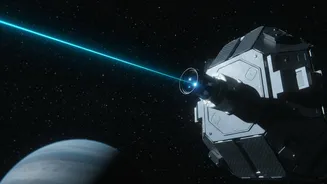
A laser communication system consists of three main parts: a transmitter, a telescope, and a receiver. On a spacecraft, a laser encodes data—images, video, or instrument readings—into pulses of light. This beam of light is then sent through a telescope, which focuses and aims it with incredible precision toward a receiving station on Earth or another satellite. On the ground, a large telescope, like the Hale Telescope at Palomar Observatory, collects the incoming photons. A special detector then decodes the light pulses back into digital data for scientists to analyze. Because the laser beams are so narrow and focused, they are much more secure and less prone to interference than wide-radiating radio signals.
Overcoming Earthly Hurdles
While powerful, laser communication isn't without its challenges. The biggest hurdle is the very thing the beams must travel through: Earth's atmosphere. Clouds, fog, and even atmospheric turbulence can scatter or block the laser signal, disrupting the connection. To overcome this, NASA is building a network of ground stations in geographically diverse, arid locations known for clear skies, such as in California and Hawaii. Another significant challenge is the extreme precision required. The spacecraft must aim its laser beam to hit a target millions of miles away that is constantly in motion. This is like hitting a moving dime from a mile away, requiring incredibly sophisticated pointing and tracking systems. A ground-based laser beacon is often used to help the spacecraft lock onto its target.
From Theory to Deep Space Reality
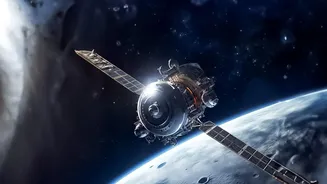
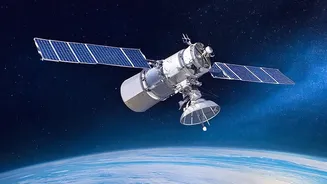
Laser communication is no longer just a theory. NASA's Deep Space Optical Communications (DSOC) experiment, riding aboard the Psyche spacecraft, has been shattering records. In late 2023, it famously streamed a 15-second high-definition video of a cat named Taters from 19 million miles away, demonstrating a data rate of 267 megabits per second—faster than many home internet connections. The system has since successfully transmitted data from as far as 226 million kilometers, proving its viability for future Mars missions. These tests are paving the way for operational use, with the upcoming Artemis II mission set to be the first to have astronauts use laser communications to send high-definition video back from lunar orbit.