


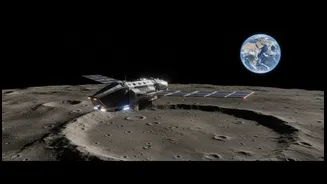


A Small Satellite with a Massive Job
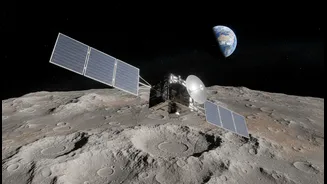
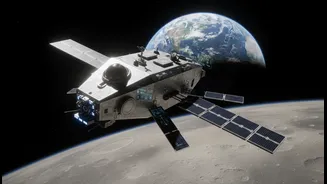
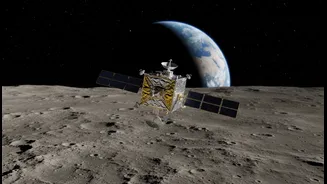
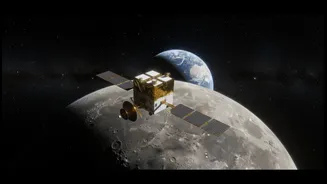
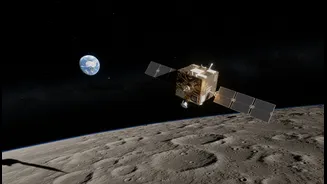
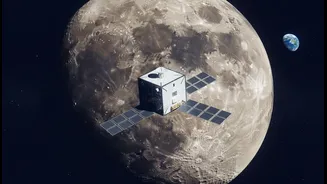
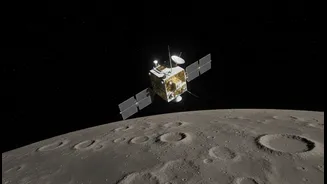
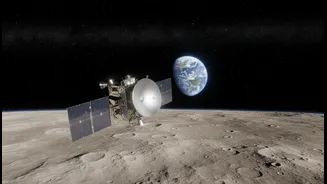
CAPSTONE, short for Cislunar Autonomous Positioning System Technology Operations and Navigation Experiment, may have a long name, but its physical presence is tiny. Weighing just 25 kg (55 pounds), this CubeSat was launched in June 2022 with an outsized
responsibility: to be a pathfinder for NASA's Artemis program. Managed by the private company Advanced Space, which also handled key technologies, and built by Terran Orbital, CAPSTONE was designed as a low-cost, rapid mission to test critical new technologies. Its main goal was to prove that a very special, and never-before-used, lunar orbit was as stable and predictable as scientists believed. The success of the future Lunar Gateway, a planned space station in orbit around the Moon, was riding on this little pioneer.
The Unique 'Halo' Orbit
At the heart of the mission was the near-rectilinear halo orbit, or NRHO. Unlike the simple circular orbits we might picture, the NRHO is a highly elongated, seven-day loop around the Moon. It’s a place of perfect gravitational balance between the Earth and the Moon, which means a spacecraft can 'rest' there with minimal fuel needed for station-keeping. This makes it an ideal staging point for future missions. During its orbit, CAPSTONE swung as close as 1,600 km to one lunar pole and as far as 70,000 km from the other. A key benefit of this orbit is that it provides a constant line of sight to Earth for communications, a crucial feature for a permanent outpost like the Gateway. Before CAPSTONE, the NRHO existed only in computer simulations; this mission was the first to fly in it and prove it works.
Smarter Navigation in Deep Space
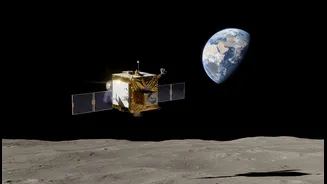
Beyond just charting the path, CAPSTONE had another major job: testing a new GPS-like navigation system for deep space. Currently, spacecraft rely on constant communication with giant antennas on Earth to know where they are. CAPSTONE tested the Cislunar Autonomous Positioning System (CAPS), designed to allow spacecraft to determine their position autonomously. It did this by communicating directly with NASA's Lunar Reconnaissance Orbiter (LRO), effectively performing a 'handshake' in lunar orbit to calculate its own position without needing guidance from Earth. The extended mission pushed this further, testing autonomous navigation software that allows a spacecraft to figure out where it is and where it's going all by itself. This technology is essential for a future where many more spacecraft are operating around the Moon simultaneously.
A Resilient Second Life
The primary mission was completed in just six months, but NASA extended CAPSTONE's life, transforming it into a flexible, in-orbit testbed. This allowed engineers to test even more cutting-edge technologies without having to launch a whole new satellite. One key experiment was with Delay/Disruption Tolerant Networking (DTN), a system designed for the realities of deep space where signals can be delayed or interrupted. Unlike our internet, which assumes a constant connection, DTN stores data when the signal is lost and automatically forwards it once communication is restored. CAPSTONE proved this technology works in a real-world lunar environment, a significant step toward more resilient deep-space communications networks.