

Beyond Little Green Men
Forget Hollywood's depiction of alien encounters. The first evidence of extraterrestrial life will likely be far more subtle. Scientists aren't scanning the skies for starships, but rather for 'biosignatures'—any measurable characteristic, substance,
or feature that can be used as evidence for past or present life. This cosmic detective work involves analyzing planets light-years away for tell-tale signs that can't be explained by geology or non-living chemistry alone. Think of it less like a greeting and more like finding a footprint in a vast, unexplored wilderness.
An Atmosphere of Possibility
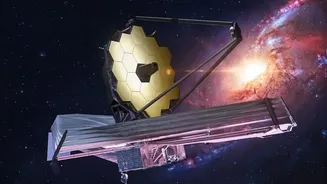
One of the most promising methods involves studying the atmospheres of exoplanets. As a planet passes in front of its star, the star's light filters through its atmosphere. By analyzing this light with a technique called spectroscopy, scientists can identify the chemical elements and molecules present. Finding gases like oxygen, methane, and carbon dioxide could be a strong indication of life. On Earth, the coexistence of methane and oxygen is a near-certain sign of biological processes, as these gases would normally react and destroy each other without a constant source—like microbes or plants—to replenish them. Finding this specific cocktail of gases on a distant world would be a major discovery.
Clues on the Surface
Beyond the air, a planet's surface might hold clues. One intriguing biosignature is the 'vegetation red edge'. On Earth, plant life absorbs red light for photosynthesis but strongly reflects near-infrared light. This creates a sharp, distinctive signal in the light spectrum. Detecting a similar signal from an exoplanet could suggest the presence of widespread photosynthesis. While we can't directly image these distant worlds in detail, powerful telescopes might be able to pick up this specific reflection of light, hinting at a world covered in alien forests or algae.
The Search for Technology
While most of the search focuses on biological signs, a branch of the Search for Extraterrestrial Intelligence (SETI) looks for 'technosignatures'—evidence of advanced technology. This could include industrial pollutants in an atmosphere, such as chlorofluorocarbons (CFCs), which don't occur naturally. Other, more speculative technosignatures include the faint heat from massive astro-engineering projects like Dyson spheres (hypothetical structures built around a star to capture its energy) or unusual radio signals that are clearly artificial and not from a natural cosmic source. Finding a technosignature would not only prove the existence of life but of intelligent, tool-building life.
The Challenge of False Positives
The greatest challenge in this search is avoiding 'false positives'—instances where non-living processes mimic the signs of life. Volcanoes can spew carbon dioxide and other gases into the atmosphere, and geological activity can create molecules that, at first glance, appear biological. For this reason, scientists are incredibly cautious. A single piece of evidence is never enough. Confirmation would require multiple lines of evidence, all pointing to a biological origin, while simultaneously ruling out every plausible abiotic (non-living) explanation. It means that the definitive discovery of life will likely be a careful, cumulative process, not a single, dramatic announcement.