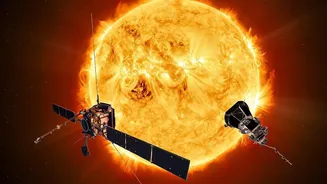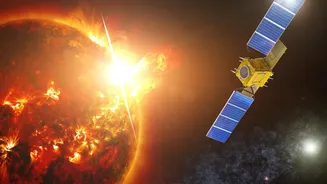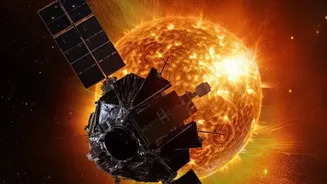





The Sun's Turbulent Weather
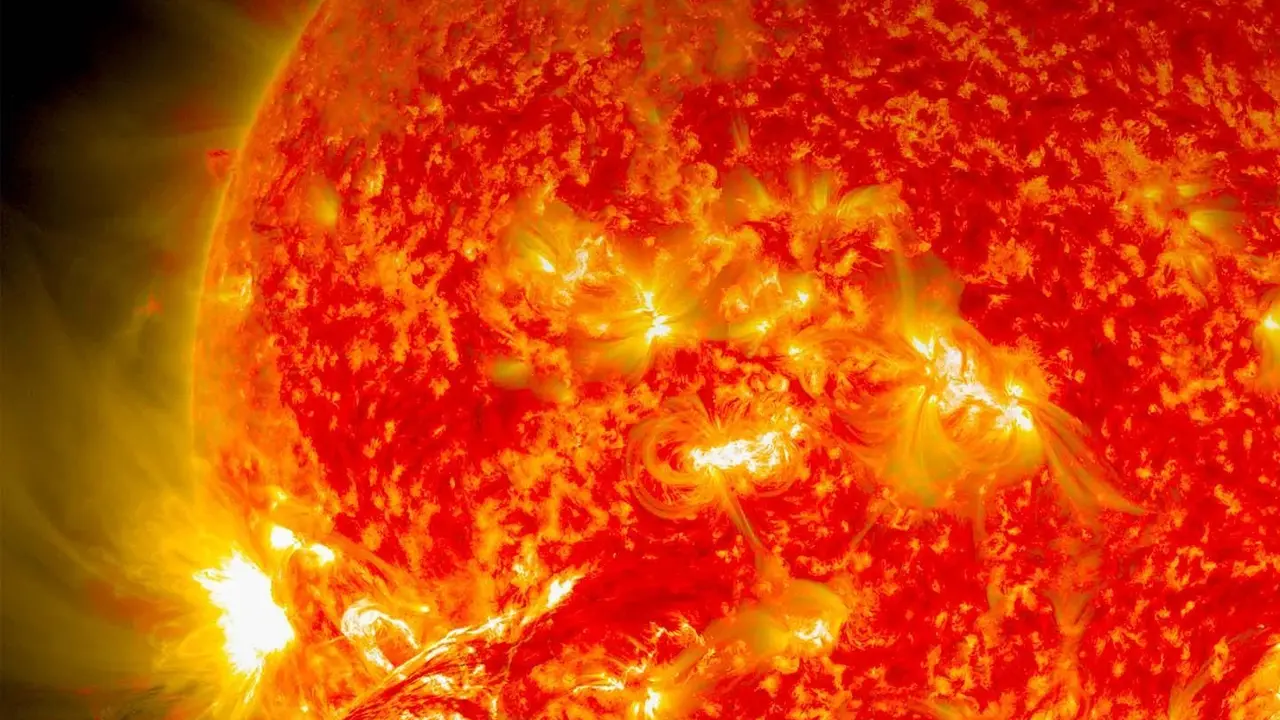
Space weather refers to the changing conditions in the space environment between the Sun and Earth. Unlike the weather in our atmosphere, it’s driven by the Sun's activity. The Sun constantly releases a stream of charged particles called the solar wind.
But sometimes, it unleashes much more powerful events: solar flares, which are massive explosions of energy, and coronal mass ejections (CMEs), which are giant clouds of solar plasma and magnetic fields hurled into space. While Earth's magnetic field protects us from most of this, a strong, Earth-directed event can have serious consequences.
A Silent Threat to Our Digital World
Modern life is uniquely vulnerable to space weather. These events can disrupt satellite operations, affecting GPS navigation, television broadcasts, and weather forecasting. A severe solar storm can cause errors in GPS signals, ranging from a few metres to a complete signal loss. It can also damage the sensitive electronics on satellites or alter their orbits. On the ground, the impacts are just as severe. Geomagnetic storms can induce powerful currents in long electrical power lines, potentially damaging transformers and causing widespread blackouts, like the one that struck Quebec, Canada, in 1989. Furthermore, high-frequency radio communications, crucial for aviation and military operations, can be completely blacked out.
Earth’s Eyes on the Sun
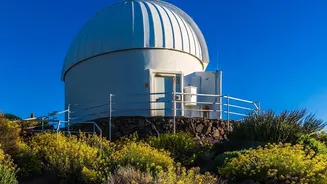
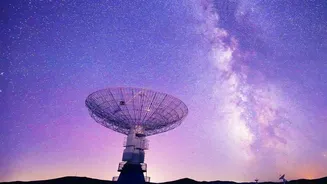
To protect against these threats, a global network of observatories constantly monitors the Sun. This network includes both ground-based telescopes and satellites. Ground observatories use specialised instruments like radio telescopes and magnetometers to track the Sun's magnetic field and activity. International collaborations like the Global Oscillation Network Group (GONG) provide continuous, worldwide observations. In India, facilities like the Indian Astronomical Observatory in Hanle, Ladakh, play a crucial role, situated in one of the world's best sites for astronomical observation due to its clear skies and high altitude. Recently, ISRO also laid the foundation for an advanced radar research complex in Assam to track space objects and bolster the country's observation capabilities.
From Data to Real-Time Warning
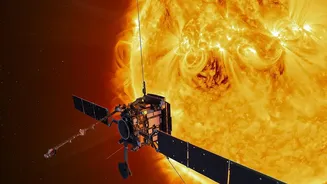
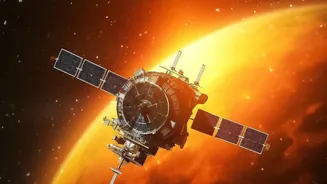
The first line of defense is often in space itself. Satellites positioned at a gravitationally stable point between the Sun and Earth, called Lagrange Point 1 (L1), act as our early warning system. Spacecraft like NASA's Advanced Composition Explorer (ACE) and NOAA's DSCOVR monitor the solar wind in real-time, giving us a precious warning of 15 to 60 minutes before a solar storm hits Earth. Data from these satellites, along with ground-based observatories, is fed into forecasting centres like NOAA’s Space Weather Prediction Center (SWPC). These centres run complex computer models to predict the arrival time, strength, and potential impact of a storm, issuing watches and warnings much like terrestrial weather forecasts.
A Global Collaborative Shield
This constant vigilance is a massive international effort. The SWPC, for example, works with partners around the world to share data and refine forecasts. The data from ground-based magnetometers helps provide real-time awareness of how Earth's magnetic field is responding to a storm. This allows power grid operators, airline dispatchers, and satellite controllers to take protective measures, such as rerouting power, diverting flights away from polar regions, or putting satellites into a safe mode. India's Aditya-L1 spacecraft, also positioned at L1, contributes vital data on solar phenomena to this global effort, reinforcing the collaborative nature of protecting our planet's technological infrastructure.