



The Junkyard Above Our Heads
For most of us, space seems vast and empty. But the region closest to home, low Earth orbit (LEO), is becoming an increasingly cluttered and hazardous environment. For decades, every rocket launch and satellite deployment has left something behind. Today,
this cosmic junkyard contains millions of pieces of debris, from defunct satellites and spent rocket stages to tiny flecks of paint and metal fragments from past collisions. More than 36,000 of these objects are larger than 10 cm and are tracked by space surveillance networks. Travelling at speeds approaching 28,000 km/h, even a small, centimetre-sized object carries the kinetic energy of a hand grenade and can catastrophically damage or destroy a functioning satellite upon impact. This poses a direct threat to the critical infrastructure we rely on daily, including GPS navigation, weather forecasting, global communications, and financial transactions.
A Cascade of Collisions
The primary fear among space agencies and satellite operators is a scenario known as the Kessler Syndrome, proposed by NASA scientist Donald J. Kessler in 1978. He theorised that if the density of objects in orbit becomes too high, a single collision could create a cloud of new debris. This new debris then increases the probability of further collisions, which in turn create even more debris, setting off a self-sustaining chain reaction. Such a cascade could eventually make certain orbits so dangerous that they become unusable for generations, effectively trapping us on Earth. While the dramatic, instantaneous orbital collapse depicted in films like 'Gravity' is an exaggeration, experts agree that the debris population is already at a critical point where collisions are generating debris faster than it can be removed by natural atmospheric drag. Recent events, like the breakup of a Chinese rocket in 2024, have added hundreds of new, high-risk fragments to already congested orbital highways, underscoring the urgency of the problem.
Enter The Magnetic Solution
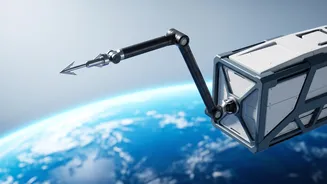
While ideas for cleaning up space have ranged from harpoons and nets to lasers and robotic arms, magnetic technology offers a unique, non-contact approach to capturing debris. Several companies and research groups are developing systems that use powerful magnetic fields to interact with orbital junk. The key advantage is the ability to influence an object from a safe distance, reducing the risk of accidentally creating more debris during a capture attempt. One leading approach involves servicers equipped with a magnetic docking mechanism. Japanese company Astroscale has already demonstrated this with its ELSA-d mission, which successfully used a magnet to capture a test satellite prepared with a compatible docking plate. This method is ideal for future satellites, which can be built with these plates from the start, allowing for easy removal at the end of their life.
How The Technology Works
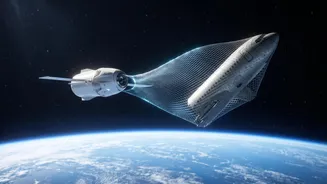
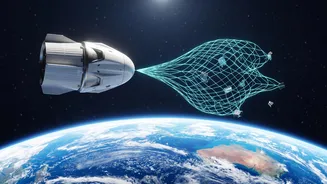
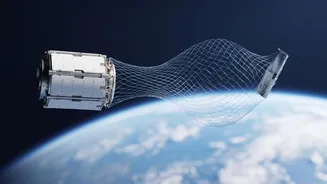
For the millions of existing debris pieces that weren't designed to be captured, engineers are developing more advanced techniques. One concept involves using a 'chaser' satellite that generates a powerful, rotating magnetic field. This field induces electrical currents, known as eddy currents, within a nearby piece of conductive debris, like an aluminium rocket body. These currents create their own magnetic field that interacts with the chaser satellite, allowing it to gently slow the debris's tumble and then tow it without physical contact. Another idea combines this with physical capture, using an electromagnetic net. Such a system could theoretically capture both magnetic and non-magnetic conductive objects, first attracting them and then ensnaring them in a net to be dragged down into Earth's atmosphere, where they would safely burn up on reentry.
Challenges And The Road Ahead
Despite the promise of these technologies, significant hurdles remain. A major challenge is that much of the existing debris is made of non-magnetic materials like aluminium. While eddy current-based systems can overcome this, they require significant power and precision. Furthermore, developing and launching active debris removal (ADR) missions is incredibly expensive, often costing millions to remove a single object. The business case is still evolving, but companies like Portal Space Systems and Paladin Space are aiming to offer 'Debris Removal as a Service' by 2027, hoping to make cleanup operations routine rather than experimental. As the commercial space economy grows and more mega-constellations are launched, the demand for a cleaner orbital environment will only increase, driving innovation and hopefully lowering the cost of these essential housekeeping missions.