





An Architecture of Patience
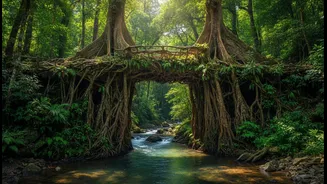
Deep in northeastern India, the Khasi and Jaintia peoples have cultivated a tradition that is a masterclass in sustainable engineering. For centuries, they have been guiding the aerial roots of the Indian rubber tree (Ficus elastica) across rivers and gorges
to form living, functional bridges. This process, locally known as “jingkieng jri,” is not a matter of quick construction but of generational patience. It can take 15 to 30 years for a new root bridge to become fully functional. The builders often use hollowed-out betel nut trunks or bamboo scaffolding to guide the young, pliable roots towards the opposite bank. Once they take hold, the real magic begins.
The Science of Self-Strengthening
Unlike steel or concrete, a living root bridge is a dynamic organism. The core reason for its increasing strength lies in a natural process called inosculation. This is where individual roots, branches, or trunks growing in close contact eventually fuse into a single, unified entity. As the roots are woven together by the bridge builders, they press against each other, and over time, their vascular tissues combine. This creates a complex, interwoven lattice that is far stronger than the sum of its parts. As the Ficus elastica tree continues to grow, the roots thicken, increasing the bridge's load-bearing capacity and rigidity. Some mature bridges can support the weight of 50 people at once.
A Bridge That Heals
Conventional bridges start to decay the moment they are completed. Steel is susceptible to corrosion and fatigue, while concrete can crack and spall, especially in harsh weather. A typical modern bridge is designed with a lifespan of 50 to 100 years, requiring constant and costly maintenance. The living root bridges, however, operate on an opposite principle. As living entities, they possess the ability to self-repair. Damage from a falling branch or the stress of a heavy monsoon season can be healed through the tree's natural growth processes. New roots can be guided to reinforce weakened sections, ensuring the structure not only endures but adapts and strengthens in response to environmental pressures.
Generations of Living Heritage
These bridges are more than just infrastructure; they are a profound cultural and ecological legacy. The knowledge of how to grow and maintain them is passed down through generations, not in written manuals, but through hands-on community practice. This intergenerational collaboration means that the people who start a bridge may not live to see it reach its full strength, making it a selfless gift to the future. Furthermore, the bridges are perfectly integrated into their environment. They stabilise the soil on steep banks, reduce erosion, and provide a habitat for other plants and animals, all while sequestering carbon throughout their centuries-long lifespan.