




More Than Just a Launch
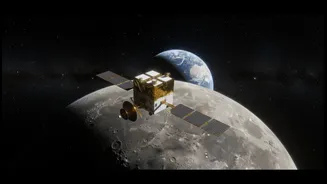
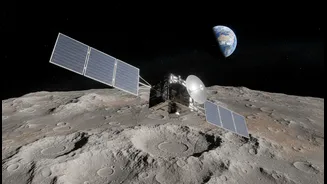
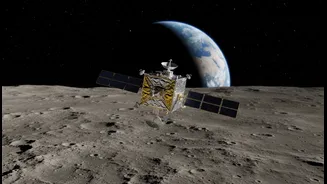
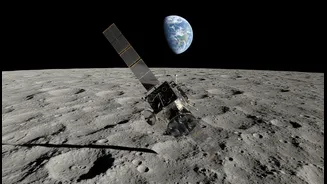
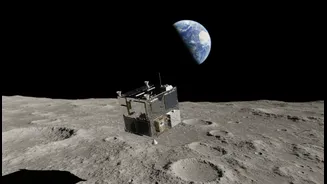
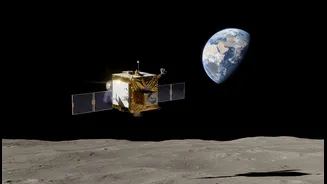
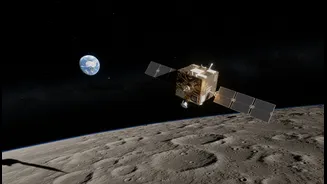
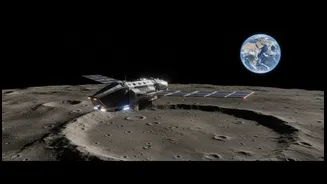
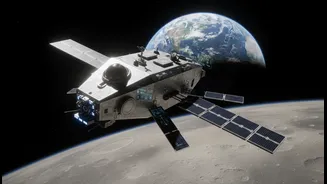
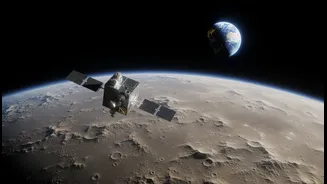
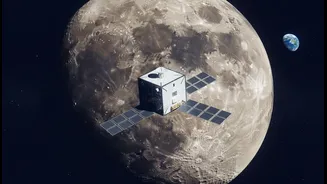
Launched in June 2022, the Cislunar Autonomous Positioning System Technology Operations and Navigation Experiment, or CAPSTONE, is a small satellite with a giant mission. Weighing just 25 kilograms, this CubeSat was designed not for grand scientific discovery,
but to solve fundamental engineering and logistical problems standing in the way of humanity’s return to the Moon. It's a pathfinder, designed to test the technologies and techniques that will underpin NASA's Artemis program and the Lunar Gateway, a future orbiting outpost. The mission, a partnership between NASA and the private company Advanced Space, showcases a faster, more cost-effective approach to space exploration, proving that small, focused missions can retire significant risks for larger, more complex endeavours.
The Challenge of a New Orbit
At the heart of the CAPSTONE story is its destination: a Near-Rectilinear Halo Orbit (NRHO). Unlike the relatively simple, circular orbits of the Apollo era, the NRHO is a highly elliptical, finely balanced path in cislunar space. This orbit is a gravitational sweet spot, influenced by both the Earth and the Moon, which provides remarkable stability. For an outpost like the Gateway, this stability means it requires minimal fuel to maintain its position, making it ideal for a long-term presence. The orbit swings from as close as 1,600 kilometres to one lunar pole to as far as 70,000 kilometres from the other. Before CAPSTONE, the stability of this orbit was only theoretical. A primary objective of the mission was to be the first spacecraft ever to enter and operate in an NRHO, validating NASA's models and providing real-world data on the power and propulsion needed for station-keeping.
Learning to Navigate Without GPS
On Earth, we take GPS for granted. In the vastness of cislunar space—the region around the Moon—there is no such system. Historically, spacecraft have relied on constant communication with giant antennas on Earth, a process that is slow, expensive, and creates a communications bottleneck as more missions head to the Moon. CAPSTONE's second major task was to test a revolutionary solution: the Cislunar Autonomous Positioning System (CAPS). This technology enables a spacecraft to determine its own position by communicating directly with another orbiting asset. For this test, CAPSTONE communicated with NASA’s Lunar Reconnaissance Orbiter (LRO), sending signals to it and measuring the response to calculate its own position and trajectory autonomously, without input from the ground. This successful demonstration is a game-changer, paving the way for future lunar missions to navigate independently and free up Earth-based networks for critical science data.
A Pathfinder for Artemis
Every success of the CAPSTONE mission directly reduces the risk for NASA's Artemis program. By being the first to fly the NRHO, it has provided invaluable experience for the future Lunar Gateway, which will use the same orbit as a staging point for human missions to the lunar surface. Verifying the orbit's dynamics means that when the multi-billion dollar Gateway arrives, its operational plan will be based on proven data, not just simulations. Similarly, the demonstration of autonomous navigation with CAPS is foundational for the entire ecosystem of landers, rovers, and support craft planned for the Moon. This capability will allow for more complex and coordinated operations in lunar orbit and on the surface. CAPSTONE's journey, including overcoming in-flight anomalies, has provided crucial lessons in operating small, sophisticated spacecraft in deep space.
Small Satellite, Big Precedent
Perhaps the most significant aspect of the CAPSTONE story for the engineering community is how it was achieved. Developed for around $30 million, the mission demonstrated that small, commercially developed satellites can execute high-stakes technology demonstrations far from Earth. Managed by Advanced Space and built by Terran Orbital, the 12U CubeSat was launched on a Rocket Lab Electron rocket, showcasing an end-to-end commercial approach. This model—leveraging small business innovation and commercial partnerships—offers a path to accelerate the pace of space exploration. It proves that pathfinder missions don't need to be massive, decade-long projects. Instead, they can be nimble, cost-effective, and still provide enormous value, testing key technologies before they are integrated into flagship missions.