


The Galactic Gold Standard
For decades, the mantra for planet hunters has been "follow the water." Life as we know it requires liquid water to exist, so astronomers have focused their search on the 'habitable zone' around stars. This is the orbital sweet spot—not too hot, not too cold—where
a planet’s surface could potentially host liquid oceans. Finding a rocky planet in this zone was long considered the jackpot. The discovery of water vapour in an exoplanet's atmosphere has been hailed as a monumental step, bringing us closer to answering whether we are alone in the universe. But science is a story of ever-increasing detail, and the latest generation of tools is showing us that even this simple rule has complicated exceptions.
A Steamy, Complicated Reality
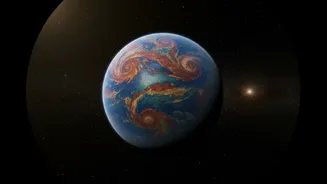
Recent observations, many from the powerful James Webb Space Telescope (JWST), are painting a much more nuanced picture. Scientists are now detecting water vapour on worlds that defy easy categorisation. Take, for instance, the discovery of 'steam worlds' like GJ 9827 d, a planet roughly twice Earth's size with an atmosphere consisting almost entirely of hot water vapour. While it has abundant water, its sweltering temperature makes it inhospitable for life as we know it. Other times, the signal for water is ambiguous. On the rocky world GJ 486 b, scientists detected water but cannot yet be sure if it belongs to the planet's atmosphere or is simply coming from cool spots on its host star. These findings don't disprove the water rule, but they do add crucial asterisks.
Not All Water Is Life-Giving
The key takeaway is that the context of the water matters immensely. A planet can have water vapour but be in a 'moist greenhouse' state, where surface temperatures are scorching and the water is lost to space over millions of years. An atmosphere might be rich in water, but the planet could be a 'sub-Neptune' with a dense hydrogen-helium envelope and no solid surface. Furthermore, a planet's star plays a huge role. Active red dwarf stars, the most common type in our galaxy, can blast their nearby planets with radiation, potentially stripping away atmospheres and making them hostile to life even if they are in the habitable zone. Therefore, habitability is not just about a single ingredient, but a complex recipe of geophysical and stellar factors.
New Tools, New Questions
The ability to even have these conversations is a testament to incredible technological advancement. The James Webb Space Telescope, with its unparalleled sensitivity, can capture the faint light filtering through an exoplanet's atmosphere during a 'transit'—when the planet passes in front of its star. By analysing this light spectrum, scientists can identify the molecular fingerprints of gases like water vapour, methane, and carbon dioxide. This has moved the field from just finding planets to actually characterising their environments. For every answer these powerful new tools provide, they seem to generate more profound questions, pushing astronomers to refine their models of how planets form and evolve.