







The Perennial Problem
For any hilly state, roads are more than just transport corridors; they are vital arteries for trade, healthcare, and daily life. In Mizoram, a state defined by its mountainous terrain and intense monsoon season, keeping these arteries open is a constant
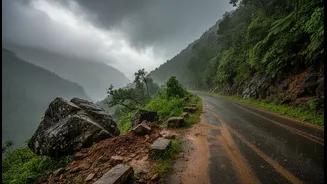
battle. Landslides are a frequent and destructive reality, often triggered by heavy rainfall on fragile slopes. Traditionally, road construction and repair have relied on conventional civil engineering—concrete retaining walls, steel structures, and extensive earth-cutting. This approach is not only expensive but often proves inadequate against the region's powerful natural forces. The cycle of building, destruction, and rebuilding consumes a significant portion of public funds and leads to prolonged disruptions, isolating communities and hampering economic development.
A Greener, Smarter Solution
In response to these challenges, Mizoram, with support from the World Bank, pioneered an innovative strategy focused on bio-engineering. This “green infrastructure” framework moves away from a complete reliance on concrete and instead uses vegetation and local, natural materials to stabilize slopes and protect roads. The core idea is simple yet powerful: work with nature, not against it. Bio-engineering involves using carefully selected plants—grasses, shrubs, and trees—either alone or in combination with minimal civil structures to create resilient, living barriers that hold the soil together. This not only protects the road from landslides but also helps maintain the productivity and ecological balance of the hillsides, a crucial factor for local agricultural communities.
How Bio-Engineering Works
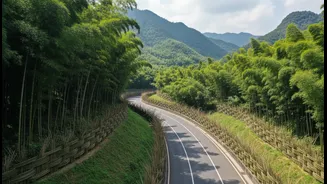
The techniques employed are tailored to the local environment, making extensive use of Mizoram's abundant bamboo. Drawing on local knowledge, engineers developed methods like bamboo terracing and crib walls. These structures are embedded into the hillside and then planted with fast-growing, deep-rooted local flora. The plants' root systems interlace with the soil, creating a strong, natural matrix that prevents erosion. Wire-mesh netting is also used to hold the surface of a slope in place while the vegetation takes root. This approach is significantly faster to implement than building massive concrete walls, a critical advantage in a state with a short construction season of only six to seven months between monsoons.
The Staggering Cost Savings
The economic benefits of this green framework are transformative. According to World Bank reports on the Mizoram State Roads Project, implementing bio-engineering measures across 105 sites cost approximately US$90,000. The estimated cost for protecting the same area using conventional concrete and masonry works would have been between US$650,000 and US$1 million. In one instance, a site that would have cost US$62,000 to secure with traditional methods was stabilized for just US$5,000 using bio-engineering. These massive savings are achieved by using locally sourced materials like bamboo and employing local labour, which eliminates the need to bring in skilled workers and expensive materials from outside the state. This approach also generated an estimated 130,000 person-days of local employment, fostering strong community ownership of the infrastructure.
A Model for the Himalayas
The success in Mizoram has demonstrated that climate-resilient infrastructure doesn't have to be prohibitively expensive. In fact, the project proved its mettle during the region's highest rainfall in a decade in 2007, when the bio-engineered slopes remained stable with minimal damage while conventional structures suffered. The initiative has since become a blueprint for other Himalayan states. Based on the experience in Mizoram, a comprehensive manual of bio-engineering techniques was developed and implemented in the Himachal Pradesh State Roads Project. As extreme weather events become more frequent across India due to climate change, this nature-based model for building and maintaining infrastructure offers a sustainable, cost-effective, and community-centric path forward.