
A Sharper View of the Dawn
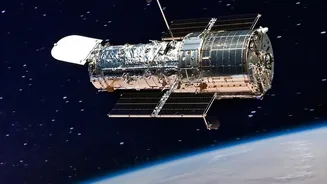
The latest game-changing images come from the James Webb Space Telescope (JWST), a marvel of engineering that observes the universe in infrared light. This allows it to see through cosmic dust and capture the faint light from the universe's first galaxies.
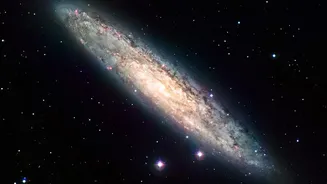
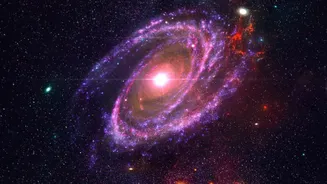
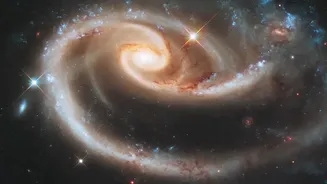
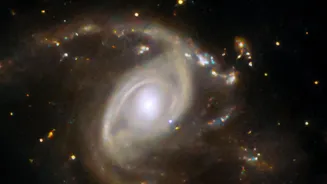
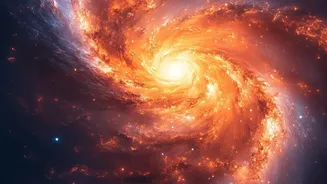
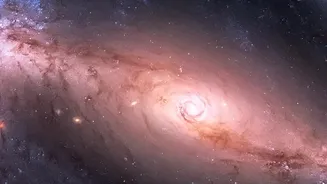
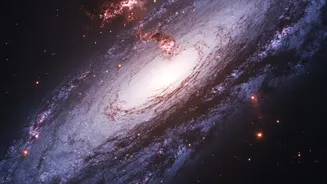
Recent findings have revealed galaxies that appear far more mature and structured than anyone expected for such an early period. Some are seen when the universe was only a few hundred million years old, a mere fraction of its current 13.8 billion-year age, yet they look surprisingly settled. This isn't just a slightly better picture; it's like swapping a blurry sketch for a high-resolution photograph, revealing details that challenge old assumptions.
The Old Cosmic Story
Previously, the dominant theory of cosmic evolution was one of slow, steady assembly. This model, known as hierarchical formation, suggested that small, simple galaxies formed first. Over billions of years, these smaller structures would gradually merge and collide, building up into the large, complex galaxies we see today, like our own Milky Way. Think of it as small streams merging to form a river, which then flows into a mighty ocean. Models based on this theory predicted that the very early universe should be filled with small, chaotic, and chemically simple galaxies, not the organised structures JWST is finding. These new observations are creating serious gaps in those long-held models.
Mature Galaxies in a Toddler Universe
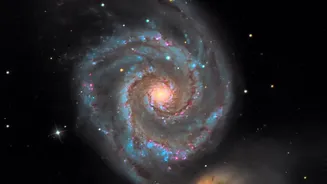
The big surprise from Webb's data is the presence of 'old' features in 'young' galaxies. For example, astronomers at Durham University identified a dense, rotating disc of stars, known as a nuclear disc, in a galaxy seen as it was over nine billion years ago. Such features were thought to take much longer to develop. Other studies show early galaxies rich in 'metals'—elements heavier than hydrogen and helium—which are produced by generations of stars. Finding them in abundance so early suggests that the first stars may have lived and died much faster than we thought, rapidly enriching their cosmic environment. It’s like finding a fully grown adult in a room you thought was only filled with toddlers; the timeline simply doesn't seem to add up.
Rewriting the First Chapters
These discoveries don't mean the Big Bang is wrong or that the age of the universe is incorrect. Instead, they force scientists to revise the first chapters of cosmic history. It appears the early universe used its time with incredible efficiency, forming complex structures much more quickly than anticipated. The focus for scientists now shifts from asking if large galaxies existed early on to figuring out how they did. Researchers are scrambling to update their computer simulations and theoretical models to account for this rapid development. It suggests that some fundamental processes, perhaps related to how black holes grow or how the first stars behaved, are missing from our current understanding.