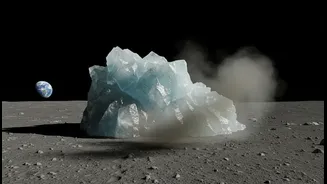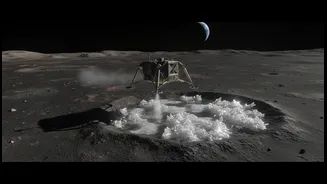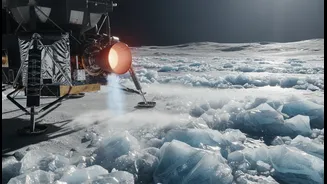




What Are These Pristine Deposits?
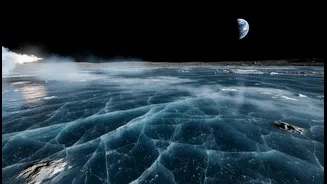
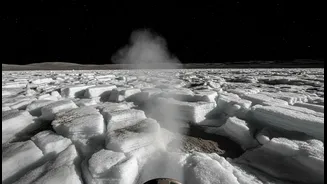
At the Moon's poles are regions that have not seen sunlight for billions of years. These Permanently Shadowed Regions (PSRs) are incredibly cold, acting like natural cold traps. Scientists believe these frigid craters contain vast deposits of water ice,
mixed with lunar dust (regolith). This isn't just frozen water; it's a potential historical record. This ice could contain molecules from comets and asteroids that impacted the Moon long ago, including 'prebiotic' organic molecules that might hold clues to how life originated in our solar system. It's a finite, irreplaceable scientific treasure that could tell us about the history of water and life, making it immensely valuable for both science and for future explorers who might use it as a resource.
The Contamination Culprits
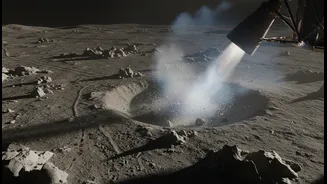
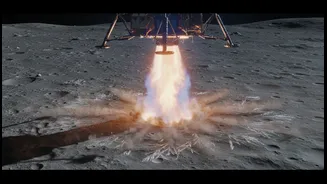
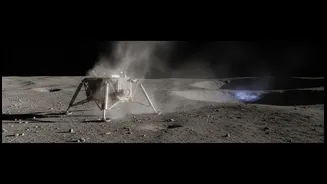
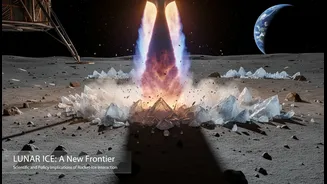
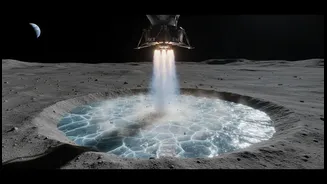
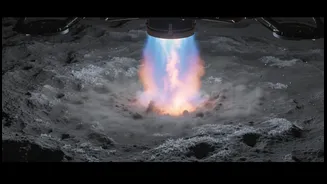
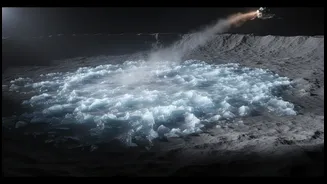
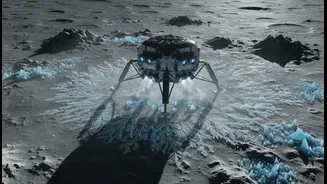
The primary threat comes from the exhaust of lunar landers. Spacecraft use powerful thrusters to control their descent, and these engines burn propellants. A major concern is methane (CH4), a key component in the exhaust of many planned landers. When these gases are released, they don't just disappear. On the airless Moon, there's nothing to stop them from spreading. Recent computer simulations show that exhaust gases from a single landing at the south pole can travel across the entire lunar surface surprisingly quickly. Molecules can effectively 'hop' ballistically from one point to another, energized by sunlight until they find a cold place to settle.
A Global, Long-Lasting Problem
Simulations from a recent study are sobering. They show that within days, methane from a south pole landing can reach the north pole. Over the course of about a week, roughly half of the released methane ends up trapped in the polar regions—the very PSRs that hold the pristine ice. This means that no matter where a mission lands, it could contribute to contaminating these scientifically vital zones. The contamination isn't just a surface-level dusting. The lunar regolith is constantly churned by micrometeorites in a process called 'gardening,' which could mix the spacecraft-derived contaminants deep into the ancient ice, making it impossible for future scientists to distinguish between primordial molecules and our own pollution.
The High Cost of Unplanned Exploration
The stakes are incredibly high. The European Space Agency's planetary protection officer, Silvio Sinibaldi, has stated that our own activities could hinder scientific exploration and devalue our investment in space. By contaminating these sites, we risk masking or destroying the very evidence we are spending billions to find. It creates a paradox where the search for knowledge about our cosmic origins could be the very thing that erases it. This is not just a scientific problem; it's a business one. The long-term viability of using lunar ice for resources—to create rocket fuel, for example—depends on understanding its composition, a task made much harder by contamination.
Smarter Landings and Greener Fuels
The good news is that contamination may not be unavoidable. Researchers are calling for mission planners to be more deliberate. This includes careful selection of landing zones; some models suggest that landing in colder regions might help localize the spread of exhaust gases. More importantly, there is a growing push to develop and use 'green' propellants. Alternatives to traditional toxic fuels like hydrazine are being explored, including propellants based on hydrogen peroxide, ammonium dinitramide (ADN), and even compressed gases like nitrogen and xenon. These technologies could dramatically reduce the organic contamination footprint of future missions. NASA's planetary protection policies already require reporting of organic materials, a first step toward managing the issue.