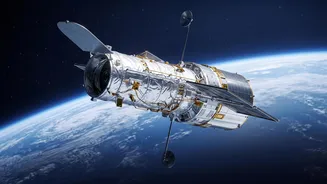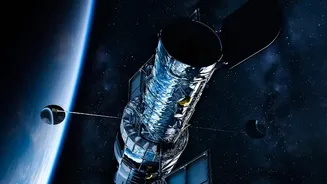






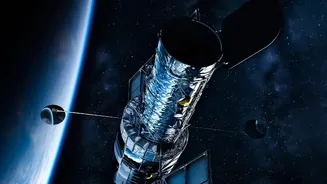
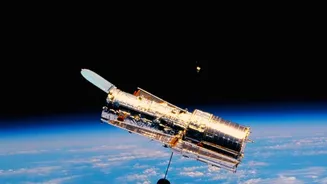
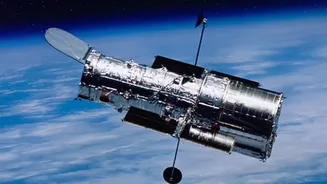
For over three decades, the Hubble Space Telescope has been humanity’s eye in the sky, revolutionizing our view of the cosmos. But its legendary mission is facing a slow, inevitable descent. Now, NASA is turning to the private sector for a rescue.
The Slow Descent of a Legend
Launched
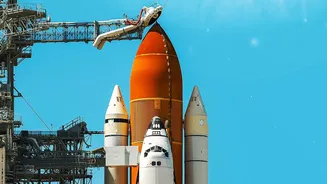
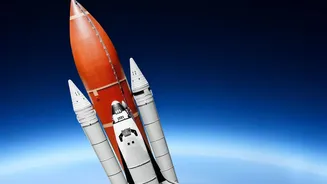
in 1990, the Hubble Space Telescope circles Earth in a low orbit, but it has no engine to keep it there. Like all objects in low-Earth orbit, it is subject to atmospheric drag—faint friction from the planet's upper atmosphere that gradually slows it down. This causes its orbit to decay, bringing it closer to Earth over time. When it was first deployed by the Space Shuttle Discovery, Hubble flew at an altitude of about 612 kilometers. Today, that has dropped to under 500 kilometers. Without intervention, NASA projects the iconic observatory will re-enter the atmosphere sometime between 2033 and 2038, where it would largely burn up. To prevent this, a decision needs to be made, and the clock is ticking.
An Unprecedented Invitation
Recognizing this deadline, NASA has officially opened the door to the commercial space industry. On October 29, 2026, the agency issued a formal Request for Information (RFI), asking private companies for concepts to save, service, or safely dispose of Hubble. The RFI outlines three main possibilities for a commercial partner: boost Hubble to a higher, more stable orbit of at least 600 kilometers; perform a servicing mission to upgrade its instruments and extend its life; or conduct a controlled de-orbit to ensure it comes down safely over an unpopulated area of the ocean. Companies have until November 30, 2026, to submit their ideas, which must include providing their own launch vehicle and spacecraft. This move signals a major shift, relying on the burgeoning private space sector for a task once handled exclusively by NASA's own Space Shuttle fleet.
Who Could Answer the Call?
This isn't the first time a private rescue for Hubble has been discussed. In 2022, NASA and SpaceX signed an agreement to study the feasibility of using a Dragon spacecraft to reboost the telescope, a study initiated in partnership with the Polaris Program, funded by billionaire Jared Isaacman. While that initial study showed it was technically possible, NASA didn't move forward with a funded mission at the time. Now, with Isaacman serving as NASA Administrator, the question has been reopened to the entire industry. Companies like SpaceX, with its proven Dragon spacecraft, are obvious contenders. Others, like Rocket Lab, known for its innovative approaches, or dedicated satellite-servicing firms such as Astroscale, could also present compelling proposals. The RFI allows for either robotic or crewed missions, leaving the architectural approach wide open.
More Than Just a Rescue Mission
Extending Hubble's life isn't just about nostalgia. The telescope remains a vital scientific instrument, producing unique observations in the ultraviolet and visible light spectrums that its successor, the James Webb Space Telescope (JWST), cannot. A successful reboost could add 15 to 25 years to Hubble's operational life, allowing it to continue making discoveries well into the 2030s and beyond. However, the challenge is significant. A recent attempt by NASA and Katalyst Space Technologies to rescue the Swift Observatory failed after the servicing spacecraft encountered technical problems, highlighting the risks involved in such complex on-orbit operations. This new call for ideas for Hubble is therefore not just a procurement exercise; it’s a test of the maturity and capability of the entire commercial space industry. How companies respond could define the future of public–private partnerships in space.