




The Universe’s Standard Recipe
The prevailing theory for how the universe took shape is known as the Lambda-Cold Dark Matter (ΛCDM) model. Think of it as a cosmic cookbook. The ingredients are about 5% ordinary matter (the stuff we see), 25% mysterious cold dark matter, and 70% dark energy,
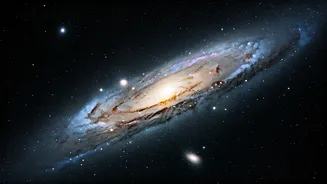
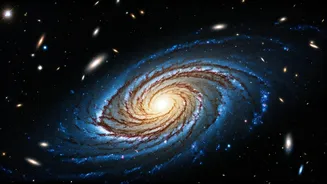
which drives the universe's accelerated expansion. In this model, structure formation is a bottom-up process. After the Big Bang, the invisible web of dark matter acted as a gravitational scaffold. Tiny fluctuations in density grew over billions of years, with dark matter clumping together and pulling in ordinary matter to form the first stars, galaxies, and eventually the massive galaxy clusters we see today, all arranged in a vast 'cosmic web'. It’s an elegant and powerful model that explains a lot about our universe.
The Anomaly: A Galaxy Without Its Skeleton
The standard model is clear: no dark matter, no galaxy. That’s why a discovery from early July 2026 is so startling. Astronomers identified a third galaxy, named DF9, that appears to be almost completely devoid of dark matter. It joins a small but growing list of cosmic oddballs. These galaxies are essentially just stars and gas, missing the vast dark matter 'halo' that should be holding them together. What makes it even stranger is that these galaxies seem to be arranged in a line, suggesting they were all formed from a single, violent event, perhaps a galactic collision that stripped the ordinary matter away from its dark matter anchor. Paradoxically, finding a galaxy without dark matter actually strengthens the case that dark matter is a real, physical substance that can be separated from normal matter, rather than just an illusion created by a misunderstanding of gravity.
A Not-So-Smooth Cosmos
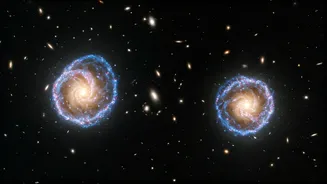
Another foundational idea, the Cosmological Principle, states that on the largest scales, the universe should be uniform and look the same in all directions. Recent data is throwing this assumption into question. A new analysis of galaxy distribution released in July 2026 shows that the universe is clumpier and has more directional patterns than predicted. This adds to the evidence of other enormous structures that shouldn't exist, like the 'Big Ring' and the 'Giant Arc'—colossal arrangements of galaxies stretching billions of light-years across the sky. These superstructures are far larger than the standard model predicts is possible. If the universe isn't as smooth as we thought, our entire model of gravity and cosmic evolution may need a serious update.
An Overachieving Early Universe
Meanwhile, the James Webb Space Telescope (JWST) has been consistently finding things in the early universe that shouldn't be there yet. According to the slow-and-steady ΛCDM model, the first galaxies should have been small and simple. Instead, JWST has seen massive, complex, and mature galaxies existing far earlier than thought possible. It has seen multi-galaxy pile-ups happening when the universe was just a fraction of its current age, a level of complexity astronomers didn't expect to see for at least another billion years. It has even spotted massive galaxies that have already stopped spinning, a sign of old age that seems impossibly premature. It feels like arriving at a party and finding it in full swing just minutes after the doors opened.