


Why Sitting Causes Stiffness
Our bodies are designed for movement. When you sit for extended periods, certain muscles adapt to that static position. Your hip flexors, the muscles at the front of your hips, remain shortened and can become tight. Your glutes can become inactive, a phenomenon
sometimes called 'gluteal amnesia'. Meanwhile, your upper back may round forward to compensate, leading to stiffness in your thoracic spine and shoulders. The goal isn't just to stretch, but to introduce movement variety to wake these areas up.
For Your Hips: Kneeling Hip Flexor Stretch
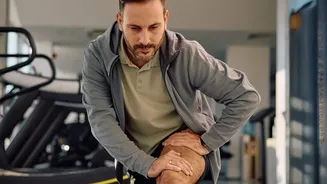
This classic stretch directly targets the hip flexors that become short and tight from hours of sitting. To perform it, start by kneeling on your right knee, perhaps on a cushion for comfort. Place your left foot flat on the floor in front of you with your knee bent at a 90-degree angle. Keeping your torso upright, gently press your hips forward until you feel a comfortable stretch in the front of your right hip and thigh. Avoid arching your lower back; the movement should come from the hips. Hold for 30 seconds, then switch sides.
For Your Spine: Cat-Cow
The Cat-Cow is an excellent movement for promoting mobility throughout the entire spine, especially the often-neglected thoracic (mid-back) region. Begin on all fours with your hands directly under your shoulders and your knees under your hips. On an exhale, round your back toward the ceiling, tucking your chin to your chest like a cat. On an inhale, drop your belly, lift your chest forward, and look slightly up, creating a gentle arch. Flow between these two positions slowly for 10-12 repetitions, synchronising the movement with your breath.
For Your Shoulders: 90/90 Hip Rotations
This drill is fantastic for improving both internal and external rotation of the hips, which is often restricted by a sedentary lifestyle. Sit on the floor and position your legs so that both knees are bent at a 90-degree angle—one in front of you and one to the side. Keeping your chest as upright as possible, slowly rotate your torso and legs to the opposite side, mirroring the 90/90 position. You can use your hands for support on the floor behind you if needed. Move slowly and with control, performing 8-10 repetitions per side.
For Your Posture: Wall Angels
To counteract the slump that comes from leaning over a keyboard, Wall Angels help open the chest and improve posture. Stand with your back against a wall, with your feet a few inches away from it. Try to keep your head, upper back, and tailbone in contact with the wall. Bend your elbows to 90 degrees and raise your arms to shoulder height, pressing your forearms and the back of your hands against the wall. Slowly slide your arms up the wall as high as you can without letting your back arch or your arms lift off. Slide back down slowly. Perform 10-15 repetitions.
For Your Whole Body: Deep Squat Hold
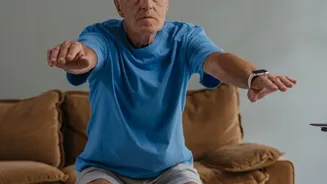
The deep squat is a fundamental human movement that mobilises the hips, knees, and ankles simultaneously. Stand with your feet slightly wider than your shoulders. Lower your hips down as if sitting in a chair, going as low as you can comfortably manage. Aim to keep your heels on the ground and your back straight. If it's difficult, you can hold onto a doorframe for support or place a book under your heels. Hold this bottom position for 30-60 seconds, breathing deeply to help your body relax into the stretch.