







An Unexpectedly Active World
When NASA’s New Horizons spacecraft flew past Pluto in 2015, it revealed a world far more complex than the static ball of ice many had imagined. Instead of an ancient, heavily cratered surface, images showed vast, smooth plains, towering mountains of water
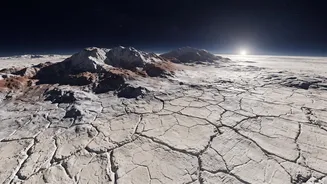
ice, and signs of ongoing geological activity. The centerpiece is Sputnik Planitia, the western lobe of Pluto’s famous heart-shaped feature, a massive basin filled with frozen nitrogen. The near-total lack of impact craters on this plain suggests its surface is incredibly young, constantly being reshaped and renewed. This discovery alone was revolutionary, proving that even small, distant worlds could be dynamic. But the data held an even bigger secret.
The Telltale Signs of Liquid
Scientists have found multiple lines of evidence pointing to liquids on or beneath Pluto's surface. Recent analysis of New Horizons images shows dark streaks at the boundaries of large, polygon-shaped convection cells in the Sputnik Planitia glacier. These features strongly resemble patterns on Earth's ice sheets that have been wetted by liquid. Since Pluto’s thin atmosphere makes nitrogen rain impossible, the most likely explanation is that liquid nitrogen is seeping up from below the glacier. Beyond this surface activity, other clues suggest a vast, hidden ocean of liquid water. The specific locations of large cracks and faults in Pluto's crust align with models of a planet that has a liquid layer between its core and its icy shell. The presence of ammonia on the surface, which should be quickly destroyed by solar radiation, also points to recent geological activity bringing it up from a liquid interior.
A Hidden Engine of Heat
The immediate question is: how can a world so far from the sun, with surface temperatures around -220°C, possibly sustain liquid? A small body like Pluto should have lost most of its internal heat from its formation billions of years ago. Scientists believe the answer lies in a combination of factors. One leading theory is that heat is generated by the slow decay of radioactive elements within Pluto's rocky core. This warmth, trapped beneath a thick insulating shell of water ice, could be enough to keep a subsurface ocean liquid for billions of years. In the case of surface nitrogen flows, computer models suggest that the immense pressure from the kilometers-deep glacier itself could be enough to melt the nitrogen ice at its base, allowing it to well up through fissures.
Redefining What's Possible
The implications of these discoveries are profound. Finding potential liquids on Pluto forces us to reconsider the conditions necessary for geological activity and even habitability. For decades, the search for life has been guided by the concept of the “habitable zone”—the narrow band around a star where liquid water can exist on a planet's surface. Pluto proves that worlds far outside this zone might still host massive, long-lived liquid water oceans, protected beneath insulating shells of ice. It suggests that the necessary ingredients for life, including liquid water and a source of energy, could be far more common in the universe than we thought. Even if the liquid is exotic, like nitrogen, its presence demonstrates that complex geological processes are not unique to larger, warmer planets.