


A Sweet Signal from the Stars
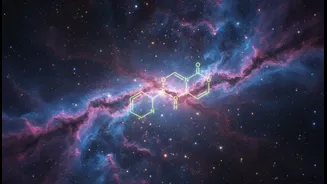
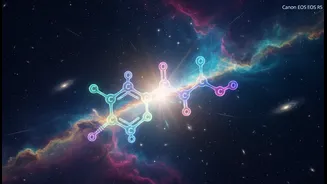
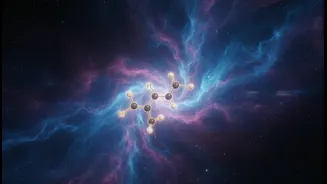
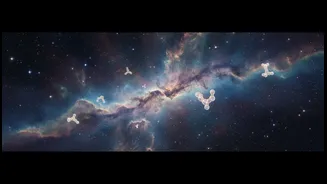
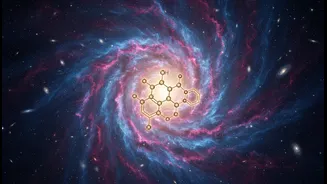
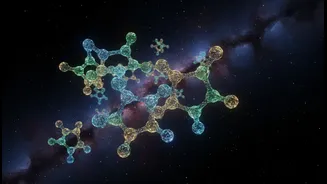
Using highly sensitive radio telescopes in Spain, an international team of researchers has identified the first true sugar in the interstellar medium—the vast, cold expanse of gas and dust between stars. The molecule, erythrulose, was pinpointed in a molecular
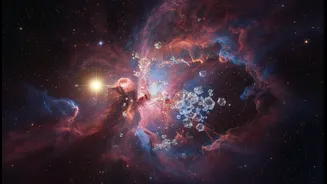
cloud named G+0.693−0.027, located about 27,000 light-years from Earth. On our planet, this four-carbon sugar is a simple compound found in raspberries and, oddly enough, used as an ingredient in sunless tanning lotions. In space, however, its presence is a monumental discovery. Scientists had previously found sugars in meteorites that had fallen to Earth, but detecting one directly in a 'stellar nursery' confirms that these crucial prebiotic molecules exist before stars and planets are even formed.
Why Sugars are a Key Ingredient
Sugars are fundamental to life as we know it. These organic compounds do more than just provide energy; they form the structural backbone of ribonucleic acid (RNA) and deoxyribonucleic acid (DNA), the molecules that carry genetic instructions in all living organisms. One of the biggest questions in origin-of-life research is how these essential molecules first appeared on Earth. Laboratory experiments trying to replicate Earth's primordial conditions have often struggled to produce sugars in the necessary quantities. This has led scientists to look to the stars, theorizing that these compounds may have been delivered to a young Earth by comets and asteroids during a period known as the Late Heavy Bombardment.
From Stardust to Your Ancestors
The detection of erythrulose in interstellar space provides a powerful link in this chain of cosmic creation. It suggests that the chemical factories for life’s building blocks are not planets, but the cold, dark clouds of gas and dust that eventually collapse to form them. Previously, discoveries of sugars like ribose in asteroid samples returned by space missions, such as from the asteroid Bennu, bolstered the theory of an extraterrestrial supply. But finding erythrulose in the interstellar medium itself is like finding flour and eggs already stocked in the cosmic pantry. It means the ingredients weren't just delivered to Earth; they were likely incorporated into our planet as it was being built.
A Cosmic Chemistry Puzzle
Interestingly, the discovery also challenges some existing theories about how complex molecules form in space. The prevailing view was that interstellar molecules grow sequentially, with smaller molecules adding one carbon atom at a time. However, researchers found that erythrulose, a four-carbon sugar, is significantly more abundant in this cloud than any simpler three-carbon sugars. This suggests a different formation pathway may be at play, possibly involving the combination of simpler two-carbon molecules on the icy surfaces of dust grains. This unexpected finding opens up new avenues for understanding the rich and complex chemistry that takes place in the universe, even in temperatures hovering around minus 250 degrees Celsius.
The Search Continues
While erythrulose isn't a direct component of RNA or DNA, its presence is a thrilling proof of concept. Scientists believe that in the right conditions, such as in water, it can transform into other molecules that are considered possible evolutionary predecessors to RNA. The discovery makes it far more plausible that other life-critical sugars, such as ribose, also exist out there waiting to be found. This find, alongside recent discoveries by the James Webb Space Telescope of other complex organic molecules in distant galaxies, is painting a new picture of the cosmos. The universe, it seems, is not sterile and empty but is instead seeded with the fundamental components needed to spark life.