



An Increasingly Crowded Sky
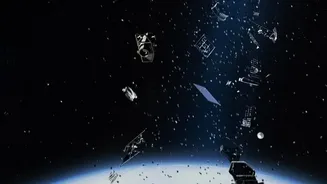
Since the dawn of the space age, humanity has left its mark on low Earth orbit, and not always in a good way. Beyond the thousands of active satellites providing us with everything from GPS navigation to weather forecasting, there is a vast and growing
cloud of space junk. As of 2026, space surveillance networks are tracking more than 29,000 objects larger than 10 centimetres, including defunct satellites and spent rocket stages. But that's just the tip of the iceberg. It is estimated there are over a million objects between 1 and 10 centimetres, and more than 140 million fragments smaller than that. Travelling at speeds of up to 28,000 kilometres per hour, even a fleck of paint can be catastrophic, capable of disabling a multi-million dollar satellite.
The High Cost of Clutter
This orbital junkyard isn't just a hazard; it's a significant economic threat. The cost of protecting satellites, performing avoidance manoeuvres, and insuring missions already amounts to 5-10% of total mission costs for some satellites. A report from the World Economic Forum projected that, even without a major collision, orbital congestion will cost the space industry tens of billions of dollars over the next decade from service interruptions and hardware replacement. The nightmare scenario is a cascade of collisions known as the Kessler Syndrome, where one impact creates a cloud of debris that triggers more collisions, potentially rendering entire orbits unusable for generations. This would cripple global communications, climate monitoring, and vital scientific research.
Enter the Space Janitors
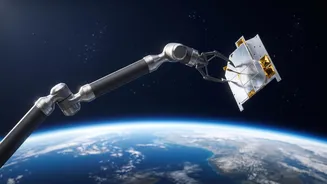
This growing crisis has created a new market: active debris removal (ADR). A wave of innovative companies and space agencies are now developing and testing technologies to actively clean up our orbital neighbourhood. The market for these in-orbit services is projected to grow exponentially, reaching nearly half a billion dollars by 2028. Companies like the Japanese startup Astroscale and the Swiss ClearSpace, commissioned by the European Space Agency (ESA), are pioneering missions to demonstrate that capturing and deorbiting space junk is not just possible, but a viable business. Their methods sound like something out of science fiction, but they are rapidly becoming a reality.
The Magnetic Dragnet
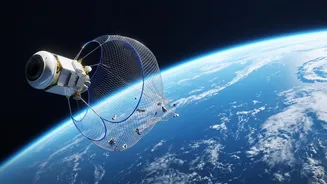
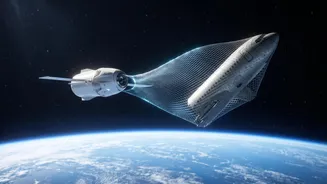
One of the most promising methods involves magnets. Astroscale has been testing a system called ELSA-d, which uses a magnetic docking plate. The idea is for future satellites to be launched with this plate attached. At the end of its life, a 'chaser' spacecraft can easily latch onto the defunct satellite and pull it down into the atmosphere to burn up safely. Other concepts involve powerful electromagnets on a space tug that can influence a target satellite from a safe distance, using its own magnetic components to attract or repel it into a decaying orbit. Researchers have also proposed deploying vast, flexible nets woven with conductive threads that could generate a magnetic field to attract and bundle smaller debris for a controlled reentry.
Harpoons and Lasers
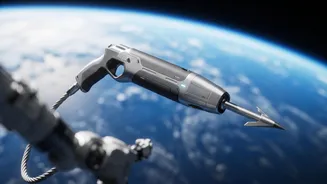
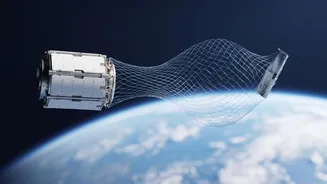
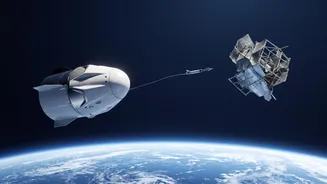
For uncooperative targets that weren't designed for capture, more aggressive methods are on the table. The RemoveDEBRIS mission, successfully concluded in 2019, tested a harpoon that could skewer a target panel, demonstrating a viable way to capture tumbling and non-responsive objects. Similarly, giant nets are being developed to envelop larger pieces of debris. Perhaps the most futuristic concept involves using ground-based or space-based lasers. Instead of destroying debris, these lasers would heat a small spot on its surface, a process called laser ablation. This creates a tiny puff of vapourised material that acts like a micro-thruster, gently nudging the object into a new, safer trajectory or hastening its descent into the atmosphere.