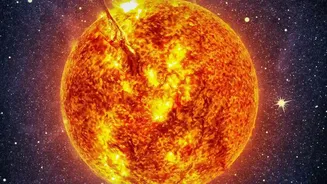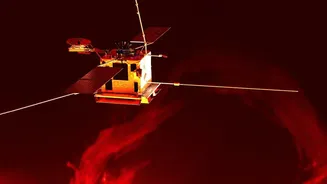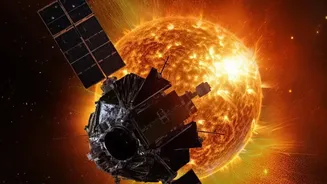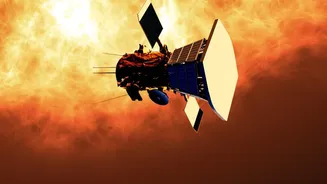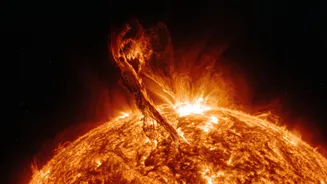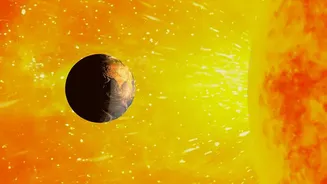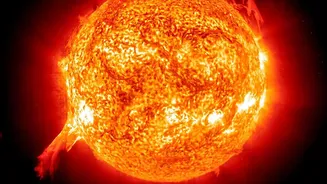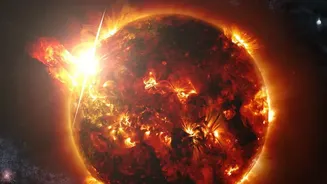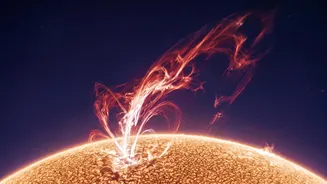


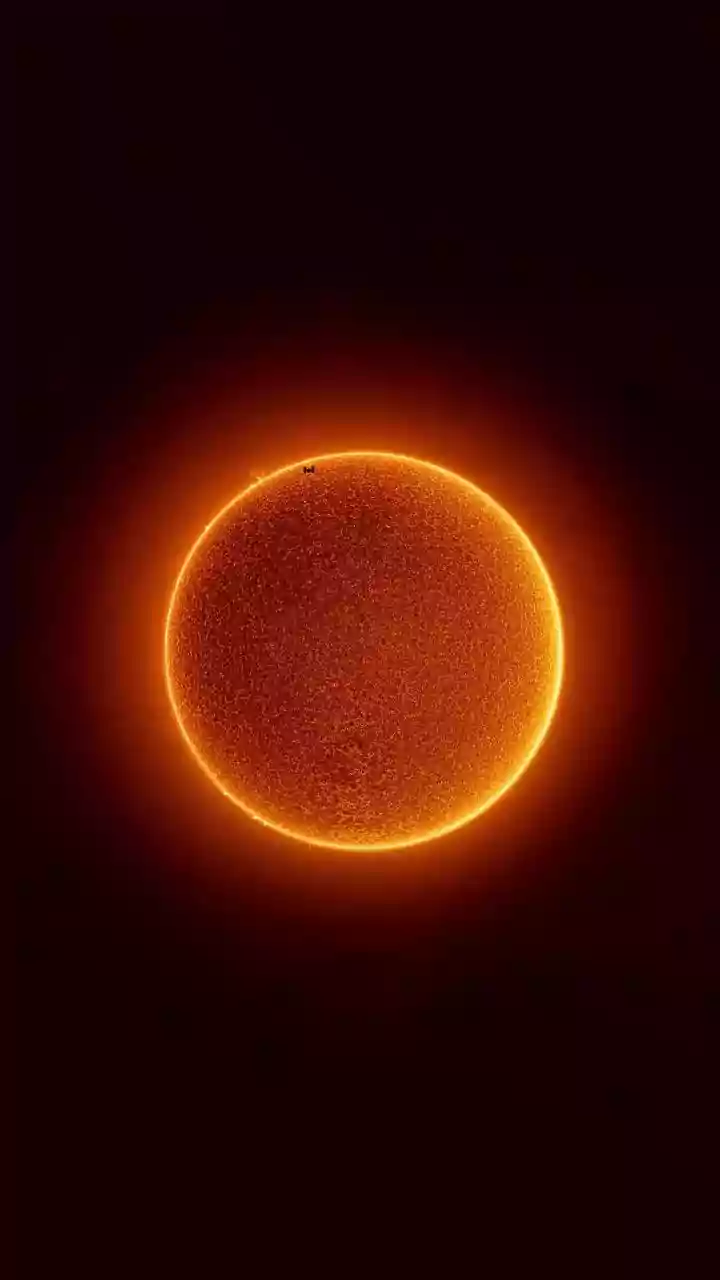
In a remarkable display of international collaboration, India's Aditya-L1 solar observatory and the European Space Agency's Proba-3 are working in tandem to unlock the secrets of the Sun's most violent outbursts. This partnership is yielding unprecedented
data.
India's Vigilant Eye on the Sun
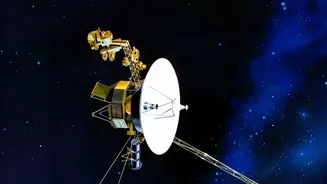
Launched by the Indian Space Research Organisation (ISRO), Aditya-L1 is the nation's first dedicated solar observatory. Positioned at a unique vantage point 1.5 million kilometres from Earth, known as Lagrange Point 1 (L1), it has an uninterrupted view of the Sun. This allows its suite of instruments to constantly monitor solar activities without the interference of eclipses or occultations. One of its key instruments is the Visible Emission Line Coronagraph (VELC), a sophisticated device developed by the Indian Institute of Astrophysics. Unlike traditional coronagraphs that simply take pictures, VELC also performs spectroscopy, splitting the Sun's light to measure the properties of the plasma in the corona, including its speed and temperature.
Europe's Artificial Solar Eclipse
The European Space Agency's (ESA) Proba-3 mission is a feat of space engineering, designed specifically to study the Sun's faint, superheated outer atmosphere, the corona. What makes Proba-3 revolutionary is that it is not one, but two satellites flying in perfect formation. Launched by an ISRO PSLV rocket, these two spacecraft maintain a precise distance of about 150 meters from each other. One satellite acts as an 'occulter', blocking the bright face of the Sun, while the other captures incredibly detailed images of the corona with its ASPIICS coronagraph. This creates a near-perfect artificial solar eclipse in space, allowing scientists to see the region very close to the solar surface where eruptions begin.
A Symphony of Scientific Instruments
The power of this collaboration lies in combining the unique capabilities of Aditya-L1's VELC and Proba-3's ASPIICS instruments. While ASPIICS captures sharp, wide-field images of a solar eruption, or Coronal Mass Ejection (CME), VELC simultaneously measures the spectrum of the light from the same event. This synergy provides a more complete, three-dimensional understanding of these massive explosions of plasma and magnetic fields. Recent joint observations of two CMEs in September 2025 demonstrated this power. ASPIICS provided clear images to estimate the eruption's shape and mass, while VELC's spectroscopic data gave independent measurements of the gas density and thermal energy. This dual approach allows for a cross-checked, more accurate picture than either mission could achieve alone.
Decoding Violent Solar Eruptions
Coronal Mass Ejections are among the most energetic events in our solar system. When aimed at Earth, these eruptions can trigger geomagnetic storms that disrupt satellite communications, damage power grids, and pose a risk to astronauts. Understanding their energy is key to predicting their potential impact. Scientists analyse three main types of energy in a CME: kinetic (energy of motion), thermal (heat), and magnetic. By combining the imaging from Proba-3 with the Doppler measurements from Aditya-L1, researchers can better track how energy is distributed and transformed during the initial, critical moments of an eruption. The joint study found significant differences between two CMEs, with one being fast and dominated by kinetic and magnetic energy, while the other was slower and showed its thermal energy growing to match its kinetic energy.