






Seeing the Universe in a New Light
Multiwavelength astronomy is the practice of studying celestial objects using data from across the entire electromagnetic spectrum. Our eyes can only detect a tiny sliver of this spectrum, known as visible light. But cosmic objects emit a vast range of light,
from low-energy radio waves to incredibly high-energy gamma rays. Telescopes on the ground and in space are designed to detect these different wavelengths. By combining images taken in radio, infrared, visible, ultraviolet, X-ray, and gamma-ray light, astronomers can piece together a much more complete picture of an object than any single image could provide. This approach is crucial for getting a comprehensive understanding of objects in space.
A Spectrum of Cosmic Clues
Each wavelength tells a different part of the story. Radio waves, for example, can reveal clouds of cold gas where stars are about to be born and trace jets of material ejected by supermassive black holes. Infrared light is perfect for peering through thick cosmic dust clouds to see young, forming stars hidden within. It can also detect cooler, older stars. Visible light, the kind we are familiar with, shows us the light from stars similar to our sun. Ultraviolet light, on the other hand, is a key indicator of very hot, young, massive stars. Finally, X-rays and gamma rays point to the most violent and energetic events in the universe, such as material falling into a black hole, superheated gas, and supernova explosions.
The Case of the Composite Galaxy
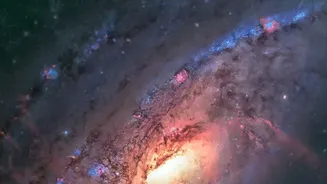
This technique has been used to create stunning and informative composite images of many galaxies. For example, combining data from NASA's Chandra X-ray Observatory with infrared data from the James Webb Space Telescope (JWST) and visible light from the Hubble Space Telescope provides a multi-layered view. In a combined image of the Cartwheel Galaxy, Webb’s infrared view shows the galaxy's rings and two smaller companion galaxies, while Chandra's X-ray data reveals superheated gas and exploded stars. Similarly, for the galaxy cluster MACS0416, combining Hubble and Webb data created one of the most colorful views of the universe, where the colors themselves give clues to the galaxies' distances and rates of star formation. The bluer galaxies tend to be closer, while the redder ones are often more distant or dusty.
India’s Eye on the Cosmos
India is a significant contributor to multiwavelength astronomy with its own dedicated space observatory, AstroSat. Launched by the Indian Space Research Organisation (ISRO) in 2015, AstroSat is uniquely capable of observing the universe in the visible, ultraviolet, and X-ray bands simultaneously with a single satellite. This capability reduces the need to coordinate between different telescopes and provides a seamless stream of data across multiple wavelengths. AstroSat carries five advanced instruments, including the Ultra Violet Imaging Telescope (UVIT) and several X-ray detectors. The mission has already made significant contributions, such as detecting far-UV photons from distant galaxies and studying fast-spinning black holes. Having completed its initial five-year mission, AstroSat's instruments remain functional, and it continues to provide valuable data to scientists in India and around the world.