





The Challenge of Atmospheric Entry
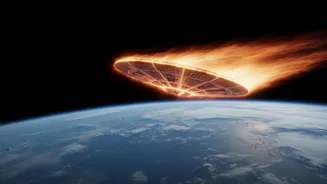
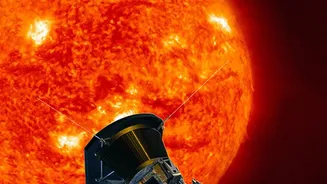
One of the biggest hurdles in space exploration isn't leaving Earth, but arriving somewhere else. When a spacecraft enters a planet's atmosphere, whether it's Earth, Mars, or Venus, it's travelling at incredible hypersonic speeds. This causes the air
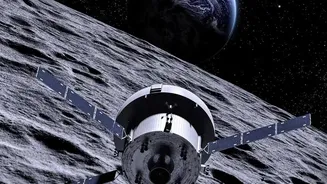
in front of it to compress, generating immense heat that can destroy the vehicle. For decades, engineers have relied on rigid heat shields, like the tiles on the Space Shuttle or the ablative shields on Apollo capsules, which burn away to dissipate heat. However, these rigid shields have a major limitation: their size is restricted by the diameter of the rocket fairing they launch in. This constraint puts a cap on how large and heavy a payload we can safely land, posing a significant problem for future ambitions like sending large habitats or heavy cargo to Mars.
An Inflatable, Game-Changing Solution
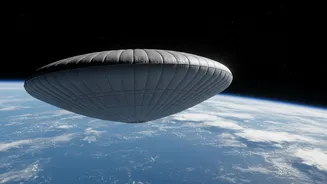
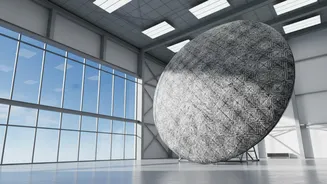
Enter the Hypersonic Inflatable Aerodynamic Decelerator, or HIAD. It is essentially a deployable heat shield that launches in a tightly packed state and inflates in space just before atmospheric entry. This simple-sounding concept is a profound engineering breakthrough. By inflating to a size much larger than any rigid shield could be, it dramatically increases the spacecraft's surface area. This larger area creates significantly more drag, acting like a massive air brake that starts slowing the vehicle down much higher in the atmosphere where the air is thinner. This process is more gradual and less violent, reducing the peak temperatures and forces the spacecraft must endure. It solves the size constraint of rockets, enabling entirely new classes of missions.
Built to Survive Extreme Heat
An inflatable heat shield is far more than just a balloon. It is a sophisticated, multi-layered system designed to withstand temperatures that can reach thousands of degrees Celsius. The core is an inflatable structure made of stacked, concentric rings, or tori. These are woven from synthetic polymers that are stronger than steel by weight, allowing them to remain rigid and maintain the shield's shape when inflated with nitrogen or another gas. This structure is protected by a flexible Thermal Protection System. The outermost layer is typically a fabric made of advanced ceramic fibres that can handle the initial shock of re-entry. Beneath this are layers of advanced insulation to prevent heat from reaching the inflatable structure itself. This combination of strength and thermal resistance allows the shield to function effectively during its perilous descent.
Proven in the Field: The LOFTID Mission
The technology took a major leap forward with NASA's Low-Earth Orbit Flight Test of an Inflatable Decelerator (LOFTID) mission in November 2022. A 6-metre diameter inflatable aeroshell was launched into orbit, inflated, and then directed to re-enter Earth's atmosphere at more than 29,000 kilometres per hour. The test was a resounding success. LOFTID survived the intense heat and pressure of re-entry, demonstrating the viability of the inflatable structure and its thermal protection system. Onboard sensors confirmed that the shield performed as expected, successfully protecting the hardware behind it and slowing the vehicle down for a safe splashdown in the ocean. The mission proved that the technology was not just a theoretical concept but a practical solution ready for future applications.
Unlocking the Future of Exploration
Inflatable heat shields are a key enabling technology for the next era of space exploration. Their ability to deliver larger and heavier payloads is crucial for establishing a sustained human presence on Mars, which will require landing habitats, life support systems, and heavy equipment. The technology could also be used to explore destinations with thick atmospheres like Venus or Saturn's moon Titan, which are challenging for rigid heat shields. Beyond deep space, these decelerators could make returning cargo and even rocket stages from Earth orbit more cost-effective and routine. By offering a lightweight, scalable, and highly effective way to manage the physics of atmospheric entry, inflatable technology is opening doors to missions that were previously impossible.