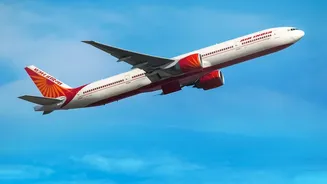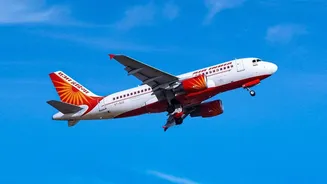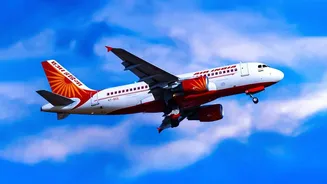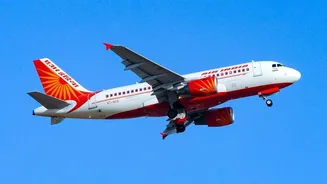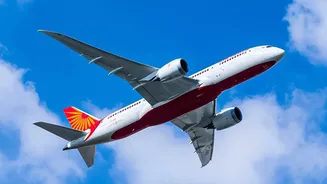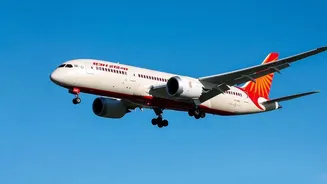






Union Minister Piyush Goyal recently stated that India needs over 1,000 additional passenger planes, on top of 1,200 already ordered. This staggering number isn't just a headline; it's a powerful indicator of the country's booming aviation story.
An Ambitious Sky-High Figure
During
a visit to Egypt, Commerce and Industry Minister Piyush Goyal announced that Indian airlines are preparing to order another 1,000 aircraft. This comes in addition to the more than 1,200 planes that carriers like IndiGo, Air India, and Akasa Air have already ordered from manufacturers like Airbus and Boeing. Goyal stated that India's total requirement is over 2,000 aircraft to meet the surging demand for air travel. He also mentioned that the government is actively pushing manufacturers to speed up deliveries, highlighting an acute current shortage. This demand signals one of the most aggressive expansion phases in global aviation history, rooted in India's rapid economic growth.
The Engine of Unprecedented Growth
The primary driver behind this demand is India's fast-growing economy and its expanding middle class. With rising disposable incomes, air travel is transitioning from a luxury to a common mode of transport for millions. India is already the world's third-largest domestic aviation market and is projected to see its commercial aircraft fleet grow at an annual rate of 7.1% between 2026 and 2036, one of the highest rates globally. Industry forecasts predict that passenger traffic in India will grow annually by 8.9% and the number of airports will increase from around 150 to over 200 within the next decade. This growth is creating a massive, sustained need for more planes to connect more cities and increase flight frequencies.
Connecting 'Bharat' with UDAN
A key government initiative fueling this expansion is the UDAN (Ude Desh ka Aam Nagrik) scheme, launched in 2016 to enhance regional connectivity. By making flights to and from smaller Tier-II and Tier-III cities more affordable and viable, UDAN has been instrumental in democratising air travel. The scheme has successfully operationalised hundreds of new routes, connecting previously unserved or underserved airports. This has brought new regions into the national aviation network, stimulating local economies, tourism, and creating new passenger demand that requires a larger, more diverse fleet, including smaller regional aircraft. The recent extension of the scheme promises to develop 100 more airports, further boosting this regional growth.
Airlines on a Historic Buying Spree
Indian airlines have already responded to this demand with record-breaking orders. In 2023, IndiGo placed an order for 500 Airbus A320 family aircraft, the largest single purchase in commercial aviation history. The Tata-owned Air India also finalised massive orders for 470 aircraft from both Airbus and Boeing, and recently added another 100 planes to its order book. As of mid-2026, IndiGo operates a fleet of over 430 aircraft, while the Air India group (including Air India Express) has nearly 300. Newcomer Akasa Air has also grown rapidly. These existing orders, totaling over 1,200 planes, combined with the additional 1,000 mentioned by Goyal, illustrate the immense scale of the fleet expansion required.
Turbulence on the Horizon
Despite the optimism, the path to acquiring over 2,000 new aircraft is fraught with challenges. Global aircraft manufacturers are facing significant backlogs and supply chain issues, with shortages of engines and other key components. Some deliveries for existing Indian orders are scheduled as far out as 2034. Domestically, India faces a shortage of trained pilots and technical staff, with an estimated need for 35,000 new pilots and 34,000 technicians by 2035. Furthermore, rapid fleet growth will strain existing airport infrastructure, and the financial sustainability of some airlines remains a concern due to high fuel costs and intense competition.