


A Global Crisis Hits Home
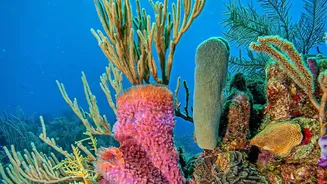
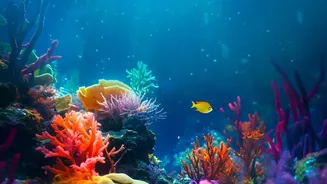
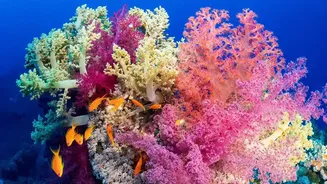
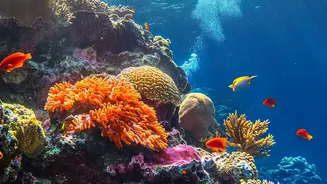
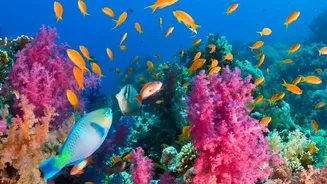
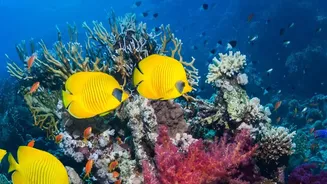
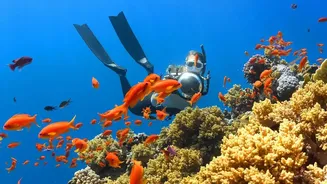
Coral reefs, often called the rainforests of the sea, are among the most diverse ecosystems on Earth. For coastal nations like India, they are indispensable, providing a critical buffer against storm surges, supporting fisheries that feed millions, and
underpinning local tourism. However, rising ocean temperatures driven by climate change are causing mass bleaching events, where corals expel the vibrant algae living in their tissues and turn ghostly white. Prolonged bleaching leads to death, threatening not only marine life but also the safety and livelihoods of coastal communities from the Gulf of Kutch to the Andaman Islands. This widespread devastation has triggered an urgent, high-tech race to save them.
Finding and Breeding 'Super Corals'
The first step is a painstaking search for nature's survivors. Scientists identify corals that have naturally withstood recent bleaching events. These resilient individuals, dubbed “super corals,” possess genetic traits that make them more tolerant to heat. The next phase, known as assisted evolution, takes place in labs and underwater nurseries. Researchers act as matchmakers, selectively breeding the strongest survivors to create offspring with even greater resilience. Another method involves exposing corals to gradually warming waters in controlled tanks, conditioning them and their offspring to better handle heatwaves. Scientists are even investigating how to modify the microscopic algae that live within corals, culturing tougher strains that can withstand higher temperatures without abandoning their coral host.
Accelerating Growth with Microfragmentation
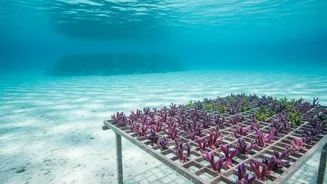
Growing a coral reef is a slow process, but biologists have found a way to dramatically speed it up. The breakthrough technique is called microfragmentation. Scientists use specialized saws to cut a single piece of coral into dozens of tiny fragments. This process triggers the coral's natural healing response, causing it to grow at a phenomenal rate—up to 50 times faster than it would in the wild. Even slow-growing, massive boulder corals, which form the bedrock of many reefs, can be grown to maturity in just a few years instead of decades. These fragments are grown in vast land-based or offshore nurseries, creating a large and genetically diverse bank of corals ready for deployment.
Planting an Underwater Forest at Scale
Growing millions of corals is one challenge; planting them on degraded reefs is another. The traditional method of manually attaching individual corals is too slow and labour-intensive for the scale required. To overcome this, scientists are innovating planting techniques. One method, known as “coral IVF,” involves capturing sperm and eggs during mass spawning events and raising millions of baby corals in floating pools before releasing them onto target reefs. Other approaches involve using specially designed clips, pucks, and other substrates that allow coral larvae to settle and grow before being placed on the seafloor. To accelerate the process further, researchers are even developing underwater drones and semi-automated robots that can efficiently deliver and plant these lab-grown corals across vast areas.
A Race Against a Warming World
Despite these incredible innovations, scientists are clear that restoration is not a silver bullet. The sheer scale of reef degradation is immense, and the costs of large-scale restoration are substantial. These techniques are designed to buy precious time and maintain functional ecosystems while the world addresses the root cause of the problem: climate change. Without a drastic reduction in global greenhouse gas emissions, even the most heat-resistant super corals will eventually reach their thermal limit. Restoration provides a crucial lifeline, preserving genetic diversity and helping to maintain the critical functions of reefs, but it cannot succeed alone. The survival of coral reefs depends on a two-pronged approach: ambitious global climate action combined with targeted, scalable scientific intervention.